AI Trending Tracks Repos and Research Feeds
A small GitHub repo called AI Trending collects AI repo links and research news sources in one place, with weekly updates and a surprisingly broad scope.

AI Trending is a tiny GitHub project with only 10 stars and 2 forks, yet it tries to solve a very real problem: keeping up with AI without opening 40 tabs every morning. The repository is basically a curated index of trending repositories, research blogs, newsletters, and learning resources, updated every Friday.
That pitch sounds simple, maybe even old-school, but there is something useful about a plain list when the AI news cycle moves faster than most people can read. Instead of another recommendation engine, appcypher/ai-trending gives you a manually organized map of where AI conversation actually happens.
What this repository actually contains
Get the latest AI news in your inbox
Weekly picks of model releases, tools, and deep dives — no spam, unsubscribe anytime.
No spam. Unsubscribe at any time.
The README is less a software project and more a directory. It groups links under sections like GitHub, AI, Latest, Old, Research News, and residency resources. There is no application logic, package manager file, or visible automation in the repo snapshot provided. The value comes from curation.

In practice, the repo points readers toward a wide mix of sources: official lab blogs, community forums, educational material, and trend pages. You get links to GitHub Trending, open-source collections like Mybridge machine-learning-open-source, and research news from places such as OpenAI, DeepMind, Google Research, and fast.ai.
- Repository stats in the source snapshot: 10 stars, 2 forks
- Update cadence stated in the README: every Friday
- Content type: curated links, not a packaged tool or library
- Main focus: trending repos, AI news, research blogs, educational resources
That distinction matters. A lot of GitHub AI projects promise tooling and end up abandoned after a few commits. This one is more like a bookmark file with public version control. If the maintainer keeps it fresh, that can be more useful than yet another half-finished dashboard.
Why a curated list still matters in AI
AI information is fragmented across company blogs, academic labs, social feeds, newsletters, GitHub repos, and media sites. Even if you already follow big names, you can still miss smaller but useful sources. A list like this reduces the overhead of deciding where to look.
It also reflects a truth that developers know well: discovery is messy. GitHub search is good for direct queries, but weak for context. News aggregators are fast, but noisy. A hand-built directory gives you a stable starting point, especially if you are trying to build a weekly reading habit instead of chasing every headline.
“I’m getting increasingly convinced that AI is going to change the world more than anything in the history of mankind. More than electricity.”
— Kai-Fu Lee
Kai-Fu Lee’s line gets quoted a lot because it captures the scale of attention around AI. But attention creates its own problem: too many inputs, too little filtering. That is the gap this repo tries to fill. It is not sophisticated, though it is practical.
There is another small advantage here. Because the repo links directly to primary sources, readers can jump straight to original posts from labs and companies instead of relying on summaries rewritten by secondhand blogs. In AI, that often means fewer mistakes and better context.
How AI Trending compares with other discovery options
If you compare AI Trending with algorithmic feeds, the tradeoff is obvious. You get less personalization, but more intentional structure. It feels closer to an editor’s reading list than a social feed.
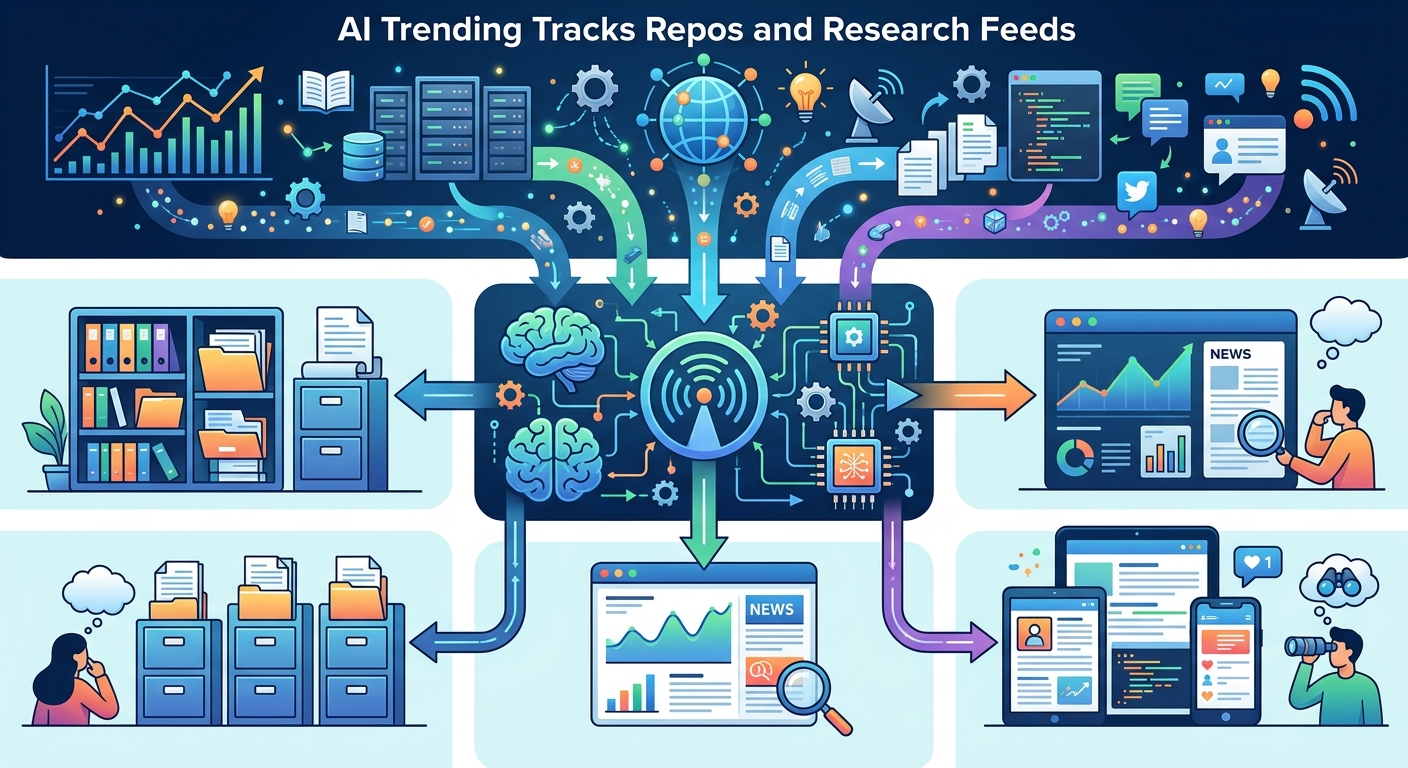
That structure also makes it easier to use for different audiences. A student can scan research blogs. An engineer can check trending repositories. A founder can watch what major labs and cloud vendors are publishing. The repo does not do the filtering for you, though it does collect the places worth checking.
- GitHub Trending: broad developer signal, updates frequently, little editorial context
- Google News AI search: huge volume, fast updates, high repetition across publishers
- Reddit r/artificial: active community discussion, mixed quality, strong opinion bias
- AI Trending: smaller scope, manual curation, direct links to source material
The weak point is scale. A one-maintainer list can go stale quickly, and this repository does not appear to include metadata, ranking logic, or automation that would help it stay current as the AI ecosystem keeps expanding. With only 10 stars in the provided snapshot, it is still very early in its life as a public resource.
Still, small GitHub curation projects often punch above their star count. Plenty of developers use niche repos privately without starring them. In a category like AI reading lists, usefulness does not always show up in vanity metrics.
The real test is maintenance
The best thing about this repository is also the hardest part to sustain: weekly updates. A curated list only works if someone actually revisits links, removes dead sources, and adds newer ones. AI blogs disappear, company URLs change, and research groups move their publishing pages all the time.
If the maintainer keeps going, the next logical step would be lightweight structure. Tags for research, tools, agents, vision, infrastructure, and education would make the repo easier to scan. A dated changelog would also help readers know what changed each week. Even a simple archive of additions could turn this from a bookmark dump into a genuinely useful monitoring resource.
There is also room for a stronger GitHub layer. The README mentions trending repositories, but the visible content leans heavily toward research news links. Pulling in a short weekly section on fast-rising repos, maybe with star growth and one-line descriptions, would make the project more balanced. We have covered similar discovery patterns before in our look at GitHub projects developers actually bookmark.
My take: AI Trending is useful right now as a starter index, especially for people building a personal AI reading routine. If it gains a few more contributors and adds basic structure, it could become a dependable weekly checkpoint. If you want to use it today, star it, fork it, and clean up the sections you care about most. That will tell you pretty quickly whether a human-curated AI index still beats another noisy feed.
// Related Articles
- [TOOLS]
Aliyun Bailian Token Plan turns credits into agents
- [TOOLS]
One API gateway turns six AI APIs into one
- [TOOLS]
OpenAI FDEs turn broken agents into shipped systems
- [TOOLS]
Anthropic’s daily brief turns news into a workflow
- [TOOLS]
Claude Reflect turns usage into retention
- [TOOLS]
Midjourney turns prompt ideas into art