Why SiFive’s P570 Gen3 matters more as a platform than a core
SiFive’s P570 Gen3 is important because RVA23 support turns RISC-V into a serious mainstream platform.
SiFive’s P570 Gen3 matters because RVA23 makes RISC-V a real mainstream platform.
SiFive’s P570 Gen3 is not just another faster RISC-V core; it is a signal that RISC-V is moving from promising architecture to practical platform. The company says the new core is RVA23-compliant, targets edge AI and rich operating systems, and scales to 16 cores, which is the kind of package that changes procurement decisions, not just benchmark slides.
RVA23 is the real headline
Get the latest AI news in your inbox
Weekly picks of model releases, tools, and deep dives — no spam, unsubscribe anytime.
No spam. Unsubscribe at any time.
The most important detail in the announcement is not the 3-wide, 13-stage out-of-order pipeline or even the vector unit. It is RVA23 compliance. That matters because software teams do not buy instruction sets in the abstract; they buy compatibility. If a core can run modern Linux distributions and Android with less custom glue, it becomes far easier to slot into commercial products that need predictable OS support and long maintenance windows.
We have seen this pattern before in computing. ARM did not win the mobile stack because of one brilliant microarchitecture; it won because the ecosystem became dependable enough for OEMs, OS vendors, and silicon partners to build around it. RVA23 is RISC-V’s attempt to create that same center of gravity. SiFive is making a bet that the market now values standardization as much as raw performance, and that bet is correct.
Vector extensions are where the market is headed
The P570 Gen3’s 128-bit VLEN vector pipeline and dot-product extensions are a clear admission that the next wave of edge silicon is about on-device inference, not just general-purpose compute. SiFive says the core can deliver up to 21X improvements on select AI workloads. Even if buyers discount that number heavily, the direction is what matters: AI acceleration is becoming a baseline expectation for high-end embedded CPUs.
This is not a niche requirement. Edge cameras, industrial gateways, retail devices, and consumer electronics all need local inference for latency, privacy, and cloud cost reasons. A core that can handle vectorized AI kernels without forcing a separate accelerator onto every bill of materials gives chip designers more flexibility. It also shortens product cycles because teams can lean on one CPU complex for more of the workload instead of stitching together a more fragile heterogeneous stack.
Performance claims only matter if the platform is usable
SiFive’s reported gains, including 7-13% SpecInt improvement and 13% lower dynamic power versus the P550 Gen1, are credible only as part of a broader system story. A faster core with poor toolchain support, immature firmware, or awkward integration is still a bad product. The announcement’s mention of AIA, a second-generation IOMMU, and WorldGuard shows that SiFive understands this. Modern SoCs are judged by the whole control plane, not the CPU block alone.
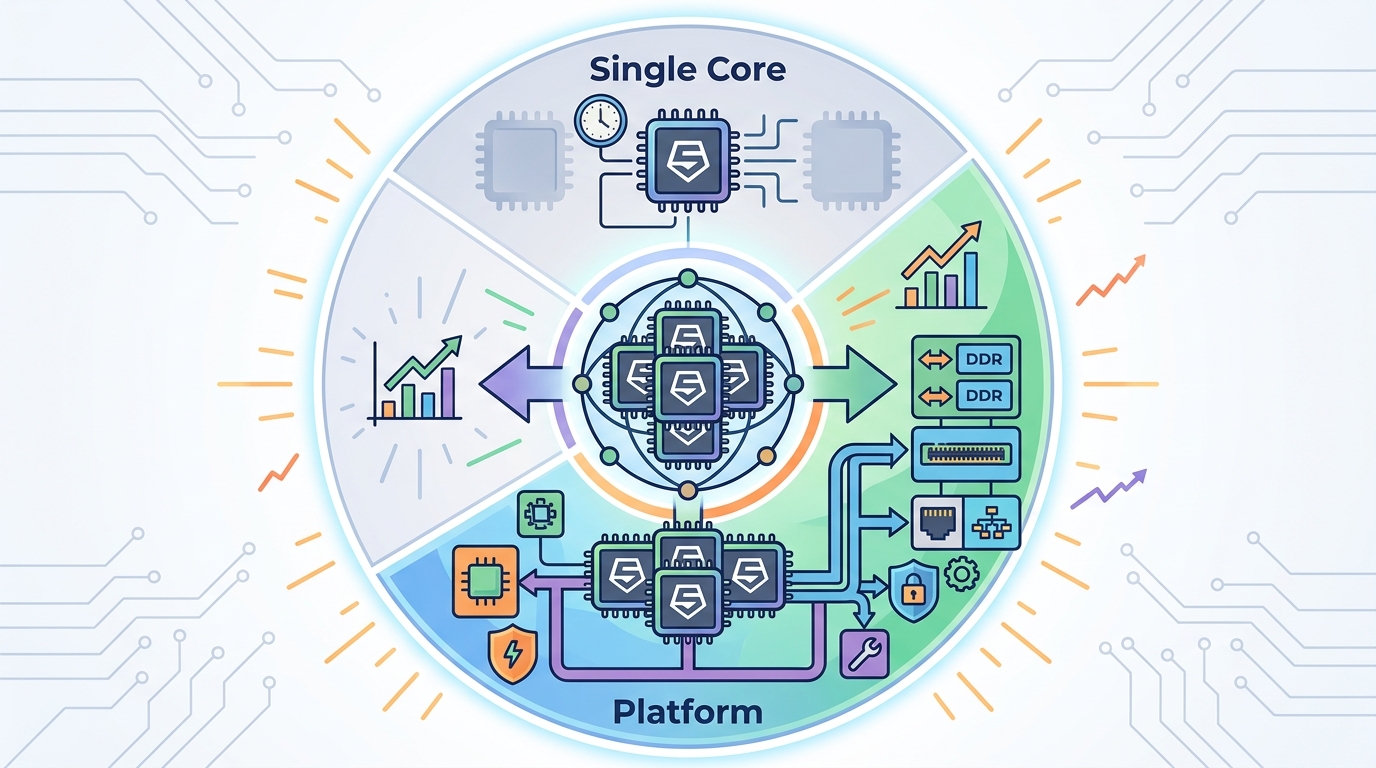
That is why the scale-up to 16 cores matters as much as the single-core numbers. Commercial IoT and edge AI products are increasingly built like small servers, with multiple isolated workloads, secure peripherals, and complex interrupt routing. A core complex that arrives with the surrounding IP needed for real system integration is far more valuable than a standalone CPU that looks good in isolation. SiFive is selling a deployable platform, and that is the right move.
The counter-argument
The skeptical view is straightforward: RISC-V vendors have overpromised before, and benchmark claims from press releases are not product reality. Toolchain maturity, upstream kernel support, and silicon availability still decide whether a core becomes a shipping design or just another architecture announcement. On top of that, ARM already has entrenched software support and a deep OEM ecosystem, so RISC-V still has to prove it can win outside enthusiast and specialty markets.
That skepticism is fair, but it misses the point of this release. SiFive is not claiming victory over ARM today. It is showing that the missing pieces are finally converging: standardized ISA support, vector capability, security primitives, and system IP that make mainstream OS deployment less painful. If anything, the cautionary lesson is that raw performance is not enough. The real test is whether vendors can ship RVA23 systems with stable firmware, upstream support, and repeatable power profiles. On that standard, this announcement is meaningful because it moves the ecosystem closer to production viability.
What to do with this
If you are an engineer, treat P570 Gen3 as a platform candidate, not a headline. Ask for silicon roadmaps, toolchain status, kernel patches, firmware maturity, and independent power data on your exact workload. If you are a PM or founder, stop evaluating RISC-V only on ISA ideology or core benchmarks. Start with deployment risk: can this chip run your OS, your security stack, your inference workload, and your thermal envelope without custom heroics? If the answer is yes, RVA23-class RISC-V is no longer experimental. It is ready for real products.
// Related Articles
- [IND]
WebX 2026 turns speaker hype into a conference brief
- [IND]
AI Weekly: 2026-07-06 ~ 2026-07-13
- [IND]
The AI Act should be treated as Europe’s operating system for AI
- [IND]
Booz Allen’s OpenAI Deal Is Real Advantage, Not Hype
- [IND]
OpenSearch’s vector search benchmark in 5 parts
- [IND]
Vector Databases That Work in Production