Top AI GitHub Repositories Dominating 2026
A 2026 roundup of the most-watched AI GitHub repos shaping how developers build apps, agents, and tooling.

These AI GitHub repositories are shaping how developers build apps and agents in 2026.
The open-source AI world is moving fast, and GitHub is where that movement shows up first. Repositories with huge star counts are still getting attention, but the more interesting signal is what developers actually keep cloning, forking, and wiring into real products.
This roundup focuses on AI projects that matter because they solve real workflow problems: coding assistance, agent orchestration, local model use, inference, and evaluation. If you build with AI, these are the names worth knowing.
| Repository | What it does | Why it matters |
|---|---|---|
| OpenAI Cookbook | Examples for using OpenAI APIs | Practical reference for shipping AI features |
| LangChain | Framework for LLM apps and agents | Still one of the most common entry points for agentic app design |
| LlamaIndex | Data framework for LLM applications | Popular for retrieval-heavy products and document workflows |
| AutoGen | Multi-agent application framework | Useful when one model call is not enough |
Why GitHub stars are only part of the story
Get the latest AI news in your inbox
Weekly picks of model releases, tools, and deep dives — no spam, unsubscribe anytime.
No spam. Unsubscribe at any time.
Stars are easy to count and easy to chase, but they do not tell you whether a repo is useful on a Tuesday afternoon when a product manager wants a demo by Friday. What matters more is whether a project has clear docs, active maintenance, and a pattern that other teams can copy without rewriting half the stack.

That is why the most important AI repositories in 2026 are often the ones that reduce uncertainty. They give developers a known path for building with models, connecting data, and adding agent behavior without starting from zero.
- Strong docs cut onboarding time.
- Frequent releases signal active maintenance.
- Real examples matter more than flashy demos.
- Clear APIs make adoption easier inside teams.
The repos developers keep returning to
The first group worth watching includes OpenAI Cookbook, LangChain, LlamaIndex, and AutoGen. These projects cover the most common AI app patterns: prompt examples, retrieval, orchestration, and multi-agent coordination.
OpenAI Cookbook is a practical library of examples rather than a framework. That makes it valuable because developers can copy patterns directly into production code. LangChain remains a broad toolkit for chaining model calls and building agent workflows. LlamaIndex focuses more tightly on connecting data sources to LLMs, which is often the real bottleneck in enterprise apps. AutoGen pushes harder into multi-agent patterns, where several model-driven components cooperate on a task.
"The next big thing in software will be systems that can reason, plan, and act," said Satya Nadella at Microsoft Build 2023.
That quote still fits the direction these repos are taking. The center of gravity has moved from single prompt-response apps to systems that can call tools, inspect outputs, and keep working across steps.
- LangChain is broad and modular.
- LlamaIndex is stronger for data-centric workflows.
- AutoGen is built for agent collaboration.
- OpenAI Cookbook is the quickest way to learn practical API patterns.
Local models and inference tools matter more than hype
Another cluster of repos has grown because teams want more control over cost, latency, and privacy. Projects such as Ollama, llama.cpp, and vLLM make it easier to run models locally or serve them efficiently.
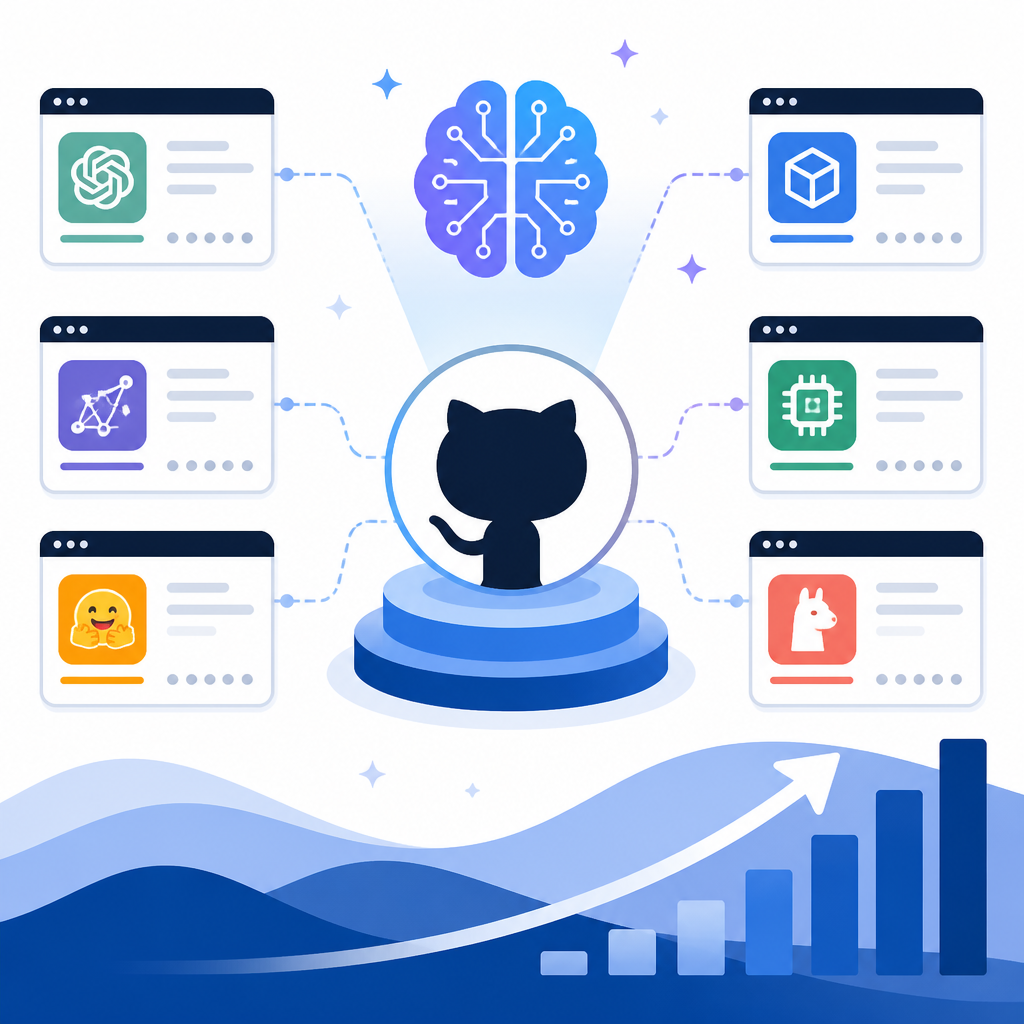
These tools matter because model access is no longer the only problem. Teams also care about where data moves, how much inference costs, and whether a product can stay responsive under load. Ollama lowers the barrier for local experimentation. llama.cpp continues to be the reference point for efficient local inference. vLLM matters for high-throughput serving, especially when teams need better utilization from the hardware they already own.
There is also a practical business angle here. Local and efficient inference tools can reduce dependency on hosted APIs, which helps when traffic spikes or compliance rules get stricter. That is one reason these repositories keep showing up in serious engineering discussions instead of just hobby projects.
What the comparison says about 2026 AI development
When you compare these repositories side by side, the differences are pretty clear. Some projects help you prototype faster, while others help you run production workloads with more control. The best teams in 2026 will probably use more than one of them.
Here is the practical split:
- OpenAI Cookbook is best for examples and API patterns.
- LangChain is best for general-purpose orchestration.
- LlamaIndex is best for retrieval and document-heavy apps.
- AutoGen is best for multi-agent coordination.
- Ollama and llama.cpp are best for local experimentation and lightweight deployment.
- vLLM is best when serving performance matters.
That split says something important about the market. AI development is no longer one category. It is a stack of problems, and the winning repos are the ones that solve a specific layer well enough that teams trust them in production.
If you want a deeper look at how agent tools are changing developer workflows, read our coverage of AI agent tooling trends. The same pattern shows up there: the projects that survive are the ones that make hard work boring.
What to watch next
The repositories that matter most in 2026 will probably be the ones that make AI systems easier to test, cheaper to run, and less fragile when they hit real users. That means better eval tooling, tighter inference engines, and cleaner agent frameworks. If you are deciding where to invest your time, start with one framework repo and one inference repo, then build something real with both.
My bet is simple: the next wave of adoption will favor projects that reduce operational pain, not the ones with the loudest launch posts. The question for developers is whether they want to keep chasing stars or start shipping with the tools that already work.
// Related Articles
- [TOOLS]
Aliyun Bailian Token Plan turns credits into agents
- [TOOLS]
One API gateway turns six AI APIs into one
- [TOOLS]
OpenAI FDEs turn broken agents into shipped systems
- [TOOLS]
Anthropic’s daily brief turns news into a workflow
- [TOOLS]
Claude Reflect turns usage into retention
- [TOOLS]
Midjourney turns prompt ideas into art