Why Amazon EKS is the wrong default for Kubernetes
Amazon EKS is powerful, but it should not be the default choice for every Kubernetes team.

Amazon EKS is powerful, but it should not be the default choice for every Kubernetes team.
Amazon EKS makes Kubernetes easier to operate, but it also locks teams into AWS-shaped decisions that are hard to unwind.
First, convenience is not the same as control
Get the latest AI news in your inbox
Weekly picks of model releases, tools, and deep dives — no spam, unsubscribe anytime.
No spam. Unsubscribe at any time.
A managed control plane removes real work, and EKS is good at that. AWS handles the Kubernetes control plane, integrates with its own security and networking stack, and now pushes even further with EKS Auto Mode for compute, storage, and networking. That is a real operational win for teams that want fewer cluster chores and faster launches.

But the same convenience narrows the field of choices. The more a team standardizes on AWS-native primitives, the more its platform starts to inherit AWS assumptions about identity, load balancing, storage, and observability. Kubernetes is supposed to reduce infrastructure coupling; EKS often replaces one form of complexity with another, more expensive kind of dependency.
Second, portability is a promise with a catch
AWS markets EKS as a way to run Kubernetes across cloud, on-premises, and edge environments, and that message is attractive to anyone building hybrid systems. EKS Hybrid Nodes, Outposts, and EKS Anywhere sound like a clean path to one operational model everywhere.
In practice, “consistent experience” is not the same as “portable workload.” The moment a team leans on AWS IAM, AWS load balancers, AWS storage classes, or AWS-specific security services, the application becomes less portable even if the YAML still looks like Kubernetes. A platform can support multiple environments while still making one environment the path of least resistance, and EKS clearly does that for AWS.
The economics favor AWS, not necessarily the team
EKS is pitched as a way to optimize cost and performance through automatic capacity planning and scaling. For a team without deep platform engineering talent, that can be a legitimate trade: pay AWS to absorb operational burden and reduce the risk of self-managed cluster mistakes.
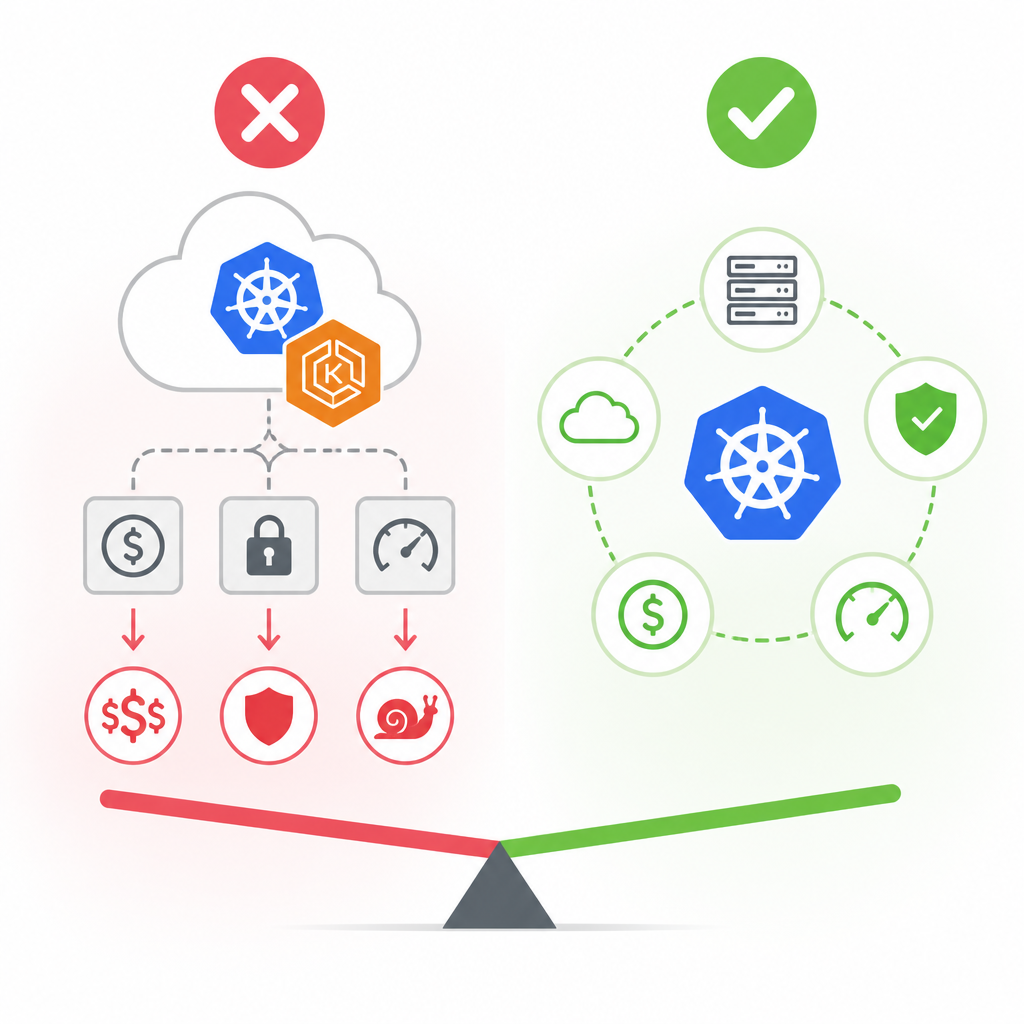
Yet cost optimization inside one cloud is not the same as business efficiency. The bill for convenience includes service premiums, adjacent AWS services, and the long-term cost of being optimized for a single provider’s ecosystem. A startup that chooses EKS because it is the easiest path today may discover later that every migration, negotiation, and architecture change is more expensive because the platform was built around AWS defaults.
The counter-argument
The strongest case for EKS is simple: most teams do not want to run Kubernetes themselves. They want production-grade reliability, security integrations, and a path to AI, data, and microservices workloads without hiring a large platform group. For those teams, EKS is not vendor lock-in so much as vendor leverage. AWS absorbs the undifferentiated heavy lifting, and the team gets to ship.
That argument is real, and for many organizations it is enough. If your primary constraint is operational maturity, not cloud neutrality, EKS is a sensible default. The problem is not that EKS is bad. The problem is that teams treat it as a neutral choice when it is actually a strategic commitment to AWS as the center of gravity.
The rebuttal is straightforward: if AWS is already your center of gravity, say so openly and design for it. Do not pretend EKS is a generic Kubernetes abstraction. It is an AWS-optimized platform with Kubernetes at the core, and that distinction matters when you care about exit options, hybrid discipline, or multi-cloud leverage.
What to do with this
If you are an engineer or platform owner, choose EKS only when AWS-native integration is part of the product strategy, not just a shortcut. Build a thin portability layer around your workloads, avoid AWS-specific dependencies unless they are deliberate, and document every place where your cluster design assumes AWS. If you are a founder or PM, treat EKS as a speed decision with a future tax: it is excellent when you want to move fast inside AWS, and a poor default when your roadmap depends on cloud optionality.
// Related Articles
- [TOOLS]
Coding Plan Pro 接入完整指南
- [TOOLS]
Windsurf turns coding into agent-driven editing
- [TOOLS]
Cursor’s latest update proves IDEs must become workflow tools
- [TOOLS]
Cursor’s Bugbot belongs before the push, not in the PR
- [TOOLS]
Prompt engineering is a writing skill, not a magic trick
- [TOOLS]
Open-Notebook turns NotebookLM into open source