Why Google I/O 2026 should be judged by Gemini, not gimmicks
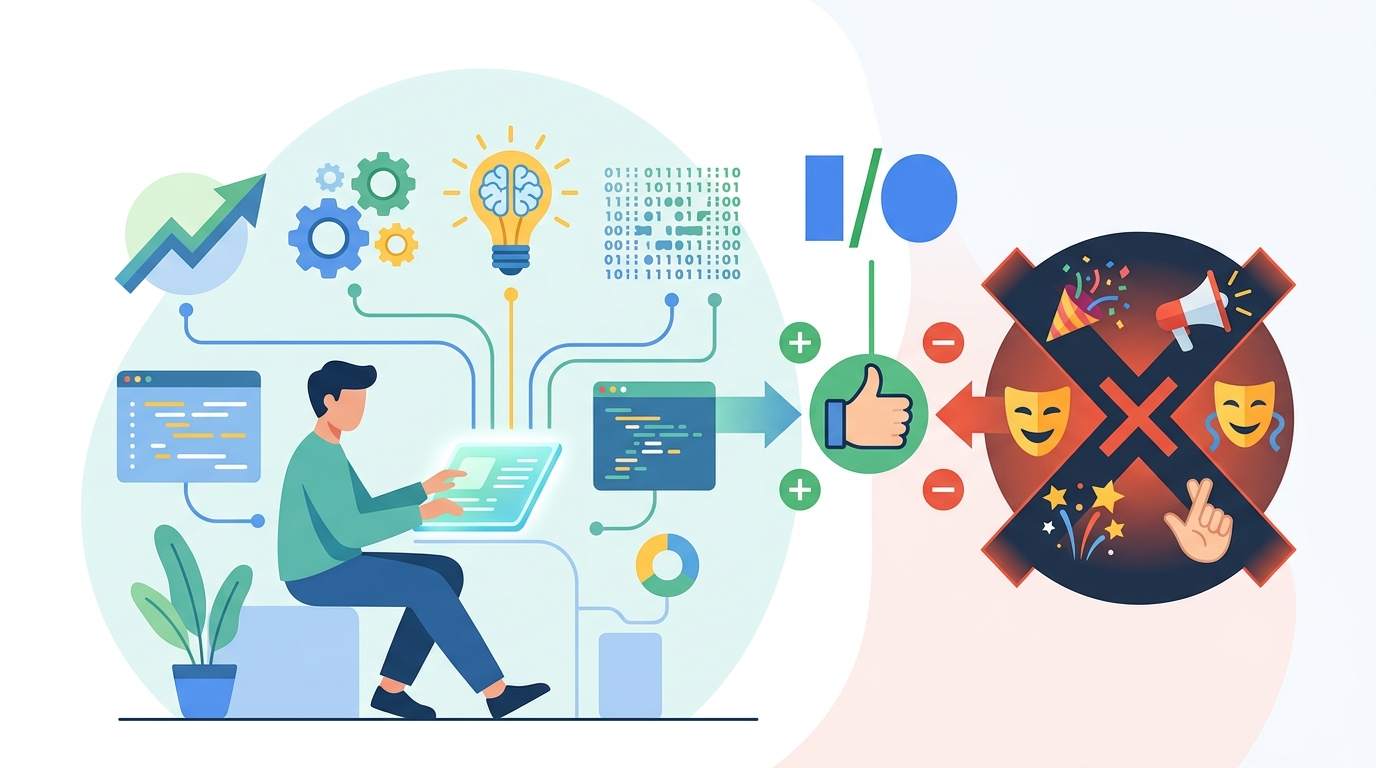
Google I/O 2026 will matter only if Gemini gets meaningfully better and more useful.

Google I/O 2026 will matter only if Gemini gets meaningfully better and more useful.
Google I/O 2026 should be judged on whether Gemini becomes a dependable product layer across Android, PCs, and XR, not on how many new logos Google can put on a slide. The company is lining up a familiar mix of announcements: Android 17 features, a possible Gemini upgrade, the long-rumored Aluminium OS, and fresh Android XR hardware. That spread sounds ambitious, but ambition is not the same thing as progress. If Google wants this event to count, it has to prove that its AI stack works in the real world and that its platform bets are more than a parade of prototypes.
Gemini is the only announcement that can move the needle
Get the latest AI news in your inbox
Weekly picks of model releases, tools, and deep dives — no spam, unsubscribe anytime.
No spam. Unsubscribe at any time.
Google’s most important product is already Gemini because it sits inside Search, Android, Workspace, cars, and a growing list of consumer surfaces. That reach is why a major Gemini release matters more than any single device reveal. A model jump, whether Google calls it Gemini 4.0 or another 3.x milestone, only matters if it improves the basics users feel immediately: faster answers, fewer hallucinations, better memory, and stronger task completion. Google has spent months adding Gemini to notebooks, cars, and Android features, which tells us the company knows the model is the platform.

The bigger story is agentic behavior. Google has already started seeding Android with features that hint at a more action-oriented assistant, and that is the right direction. A chatbot is a commodity now. An assistant that can safely complete tasks across apps, devices, and contexts is still rare. If Google uses I/O to show Gemini handling real workflows on phones and tablets, then the keynote earns its weight. If it just recycles polished demos, the company will have missed the point.
Android 17 matters, but only as the delivery system
Google is right to split Android into its own pre-I/O showcase, because the operating system is now too broad to bury inside a keynote. The Android Show on May 12 gives the company room to talk about Android 17 features without pretending the stable release is ready. That distinction matters. Beta 4 is already out, and the public should not confuse “near-final environment” with a finished product. The likely June release window is fine, but the real test is whether Android 17 makes Gemini and Google services feel native instead of bolted on.
Android has to do the unglamorous work of making AI usable. That means better permissions, clearer context sharing, tighter voice controls, and more predictable behavior across apps. A flashy model update means little if Android still makes cross-app action feel brittle. Google has a chance to show that the OS is evolving into the control plane for its AI ambitions. If Android 17 does not advance that goal, then it is just another annual version number with a few cosmetic changes.
Aluminium OS is the real platform bet, and Google should stop pretending otherwise
Aluminium OS is the announcement with the highest long-term stakes because it signals Google’s intent to build an Android-based PC operating system. That is not a side project. It is a direct attempt to extend Google’s software model beyond phones into the laptop and desktop markets, where ChromeOS has never fully escaped its limits. Sameer Samat has already confirmed a 2026 launch, and the existence of official-looking materials makes the project feel much less speculative than it did a year ago. Google should use I/O to explain what Aluminium OS is for, who it is for, and why it exists alongside the company’s other OS efforts.
The problem is that Google has a long history of treating platform transitions like marketing moments instead of product commitments. A new OS only matters if developers can build for it, OEMs can ship it, and users can understand the difference between it and what came before. If Aluminium OS is just a renamed experiment with vague Android compatibility claims, it will fail fast. If Google frames it as a serious bridge between mobile and desktop computing, backed by partners and a clear software story, then it becomes the most interesting thing at I/O by far.
The counter-argument
There is a strong case that Google I/O should not be reduced to a Gemini referendum. The company runs a sprawling ecosystem, and the keynote has to speak to developers, hardware partners, Android users, and enterprise customers at once. In that view, a broad mix of Android 17, XR, and Aluminium OS news is not distraction but proof that Google is finally thinking like a platform company again. A single-model obsession would ignore the fact that Google’s advantage comes from distribution, not just raw model quality.
That argument is fair, but it misses the hierarchy. Google can only benefit from breadth if the core layer is strong. AI is the glue holding the rest together, and Gemini is the glue’s source. Without a meaningful Gemini leap, Android 17 looks incremental, XR looks niche, and Aluminium OS looks premature. Breadth matters, but only after the company proves it can make its AI layer genuinely useful.
What to do with this
If you are an engineer, build for Gemini as a platform, not as a demo. If you are a PM, measure every Android or XR feature by whether it reduces user effort across tasks, not by how novel it sounds. If you are a founder, treat Aluminium OS as a signal that Google wants a larger share of the desktop stack and plan accordingly. The right takeaway from I/O 2026 is simple: ignore the spectacle, and watch for proof that Google can turn AI into durable product behavior.
// Related Articles
- [IND]
WebX 2026 turns speaker hype into a conference brief
- [IND]
AI Weekly: 2026-07-06 ~ 2026-07-13
- [IND]
The AI Act should be treated as Europe’s operating system for AI
- [IND]
Booz Allen’s OpenAI Deal Is Real Advantage, Not Hype
- [IND]
OpenSearch’s vector search benchmark in 5 parts
- [IND]
Vector Databases That Work in Production