Why Hà Nội weather pages matter more than headlines
Hà Nội weather pages are useful when they prioritize live conditions, hourly detail, and 7-day forecasts.

Hà Nội weather pages are useful when they prioritize live conditions, hourly detail, and 7-day forecasts.
Hà Nội weather pages are valuable because they turn a generic forecast into a practical decision tool for commuting, planning, and health. A page that shows current temperature, humidity, rainfall, air quality, and a 7-day outlook gives readers more than a headline ever can, because the difference between a dry morning and a stormy afternoon changes how people leave home, schedule meetings, and protect children or older relatives.
Live conditions beat broad forecasts
Get the latest AI news in your inbox
Weekly picks of model releases, tools, and deep dives — no spam, unsubscribe anytime.
No spam. Unsubscribe at any time.
The strongest reason to trust a local weather page is simple: weather changes faster than daily news cycles. A forecast for Hà Nội that includes current temperature, feels-like temperature, and rain probability is more useful than a citywide summary because it answers the question people actually ask at 7 a.m. before they step outside.

VnExpress’s Hà Nội weather page reflects that reality by centering current conditions first, then layering on the next 24 hours and the 7-day view. That structure matters because it matches how people use weather data in real life. A commuter does not need a poetic description of the season; they need to know whether the road will be wet, whether the heat index will spike, and whether the air will be breathable enough for a morning run.
Humidity and air quality are not optional details
In a city like Hà Nội, temperature alone is a weak signal. Humidity changes how heat feels, and air quality changes whether outdoor activity is sensible at all. A 30-degree day with heavy humidity is not the same as a dry 30-degree day, and a clear sky does not guarantee healthy conditions if pollution is high.
That is why weather pages that include humidity and air quality do better than pages that stop at max and min temperatures. The practical example is obvious: parents deciding whether to let children play outside need more than a number. Office workers choosing between a motorbike ride and public transport need the same. When a weather page includes these details, it stops being decorative and becomes operational.
A 7-day forecast is enough for planning, not for certainty
Seven-day forecasts are useful because they give people a planning horizon without pretending to predict the exact minute of a shower. For a city like Hà Nội, that is the right balance. It helps households plan laundry, travel, outdoor events, and school routines while still acknowledging that weather is inherently unstable.
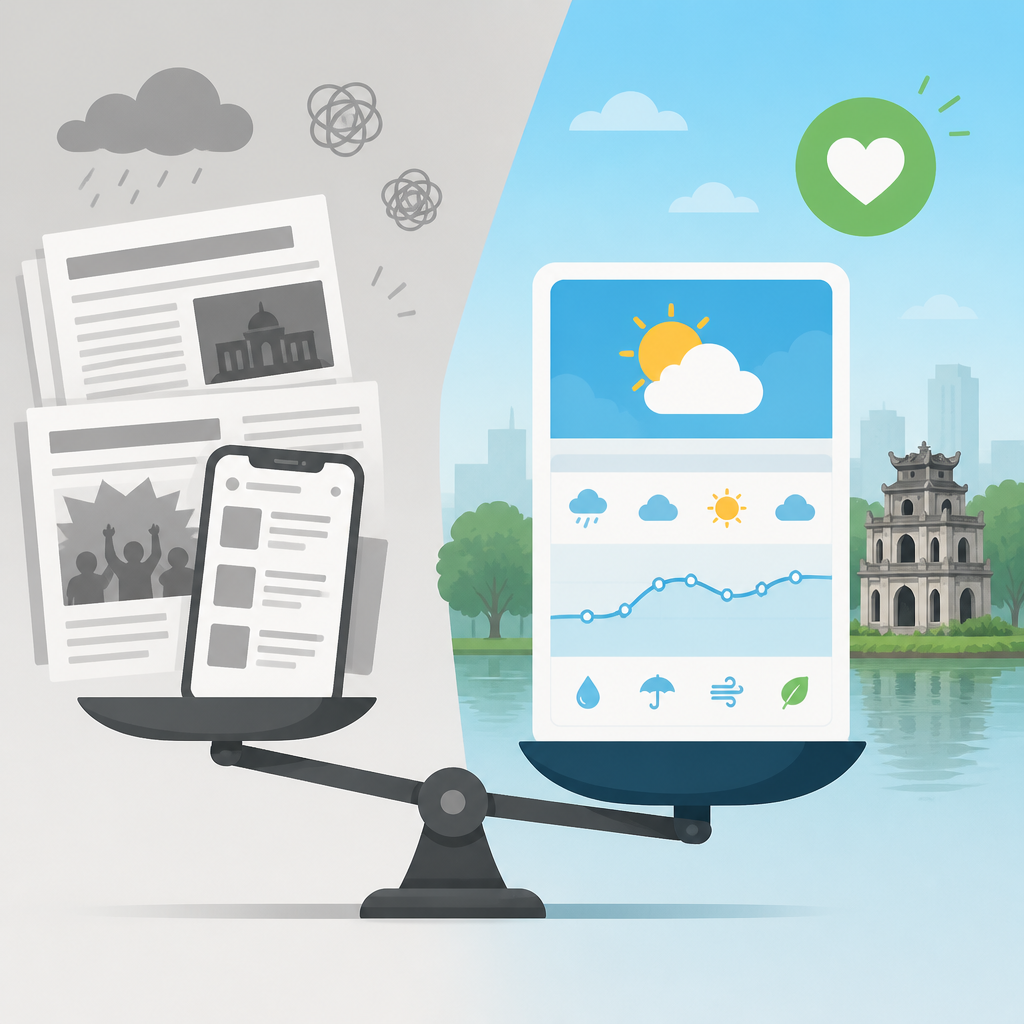
The VnExpress page, sourced from weather.com, fits this use case by offering a short-range outlook instead of an overconfident long-range promise. That is the right editorial choice. A forecast does not have to be perfect to be valuable; it has to be timely, specific, and easy to compare across days. A 7-day view does exactly that, especially when it is paired with daily highs, lows, and hourly context.
The counter-argument
Some readers argue that weather pages have become cluttered and that most people only want a single answer: will it rain today or not? That criticism is fair. Too many weather interfaces bury the main point under maps, icons, and secondary metrics, which makes simple decisions harder instead of easier.
There is also a strong case for skepticism about forecast precision. A 7-day outlook can mislead users if they treat it as a guarantee. In a fast-changing climate, confidence can become false certainty, and false certainty is worse than admitting uncertainty.
That objection fails only if the page is designed as a decision aid rather than a prediction machine. The value of the Hà Nội weather page is not that it promises exactness; it gives layered context. Users can ignore the extra detail if they want a yes-or-no answer, but the extra detail is there when the decision is more complicated than carrying an umbrella.
What to do with this
If you are an engineer, PM, or founder building local information products, design for the decision, not the display. Put current conditions first, then add hourly and 7-day views, and include humidity, precipitation, and air quality when they change the user’s choice. Keep the interface scanable, because weather is one of the few product categories where speed matters as much as accuracy. The best weather page is the one that helps people leave the house better prepared.
// Related Articles
- [TOOLS]
Nvidia and LG turn AI plans into a playbook
- [TOOLS]
Ollama is the best free AI path in 2026 for real work
- [TOOLS]
This MLOps list turns chaos into a stack
- [TOOLS]
BentoML turns model serving into Python APIs
- [TOOLS]
Magenta RealTime 2 lets you score in the DAW
- [TOOLS]
Open-source AI tools beat Claude’s paid tiers on value