Why the NVIDIA-Corning Deal Matters More Than Another AI Press Release
NVIDIA and Corning are betting that AI infrastructure now depends on U.S.-built optical connectivity, not just more GPUs.

NVIDIA and Corning are betting that AI infrastructure now depends on U.S.-built optical connectivity, not just more GPUs.
This partnership is important because it treats AI infrastructure like an industrial system, not a software story. NVIDIA says Corning will expand U.S. optical connectivity capacity 10x, raise fiber production by more than 50%, build three new plants in North Carolina and Texas, and add more than 3,000 jobs. That is not a symbolic ribbon-cutting. It is a supply-chain wager that the next bottleneck in AI will be moving data between racks, not squeezing another percentage point out of model training.
The first argument: AI is running into a physical bottleneck
Get the latest AI news in your inbox
Weekly picks of model releases, tools, and deep dives — no spam, unsubscribe anytime.
No spam. Unsubscribe at any time.
Modern AI systems are no longer limited by a single chip or a single server. They are clusters of thousands of GPUs, spread across massive data centers, all of which need to exchange data at extreme speed. NVIDIA’s own framing is the key clue here: “intelligence moves at the speed of light” only if the optical layer keeps up. When the compute stack scales this fast, fiber, photonics, and connectivity stop being boring components and become strategic infrastructure.

The market has already been telling us this. Hyperscalers are spending tens of billions of dollars on AI buildouts, and every one of those deployments increases demand for high-performance optical links. A data center can buy all the accelerators it wants, but if it cannot move data efficiently between GPUs, switches, and racks, the system underperforms. Corning’s role is not decorative. It is the plumbing that makes the AI factory usable at scale.
The second argument: domestic manufacturing is now a competitive advantage
This deal matters because it shifts a critical layer of AI infrastructure back onto U.S. soil. Corning is adding three manufacturing facilities in North Carolina and Texas, which means the U.S. is not just designing AI systems here, but also producing a core enabling technology here. In an era of tariff risk, geopolitical friction, and brittle global logistics, domestic capacity is not a patriotic slogan. It is a resilience strategy.
There is also a talent and industrial-policy angle that investors should not miss. More than 3,000 new high-paying jobs is a meaningful manufacturing footprint, not a token commitment. If AI is going to justify its “national priority” status, it has to create durable industrial spillovers beyond software engineers and cloud operators. This partnership does that by linking a frontier-tech company to a century-old materials manufacturer with deep process expertise.
The counter-argument
The skeptical view is straightforward: this is a press release dressed up as industrial strategy. NVIDIA and Corning are both publicly traded companies with strong incentives to signal momentum, and the language about “Made in America” and “once-in-a-generation opportunity” reads like investor relations, not proof of a new manufacturing era. The deal also does not solve the broader dependence of AI supply chains on global semiconductors, advanced packaging, and specialized equipment.
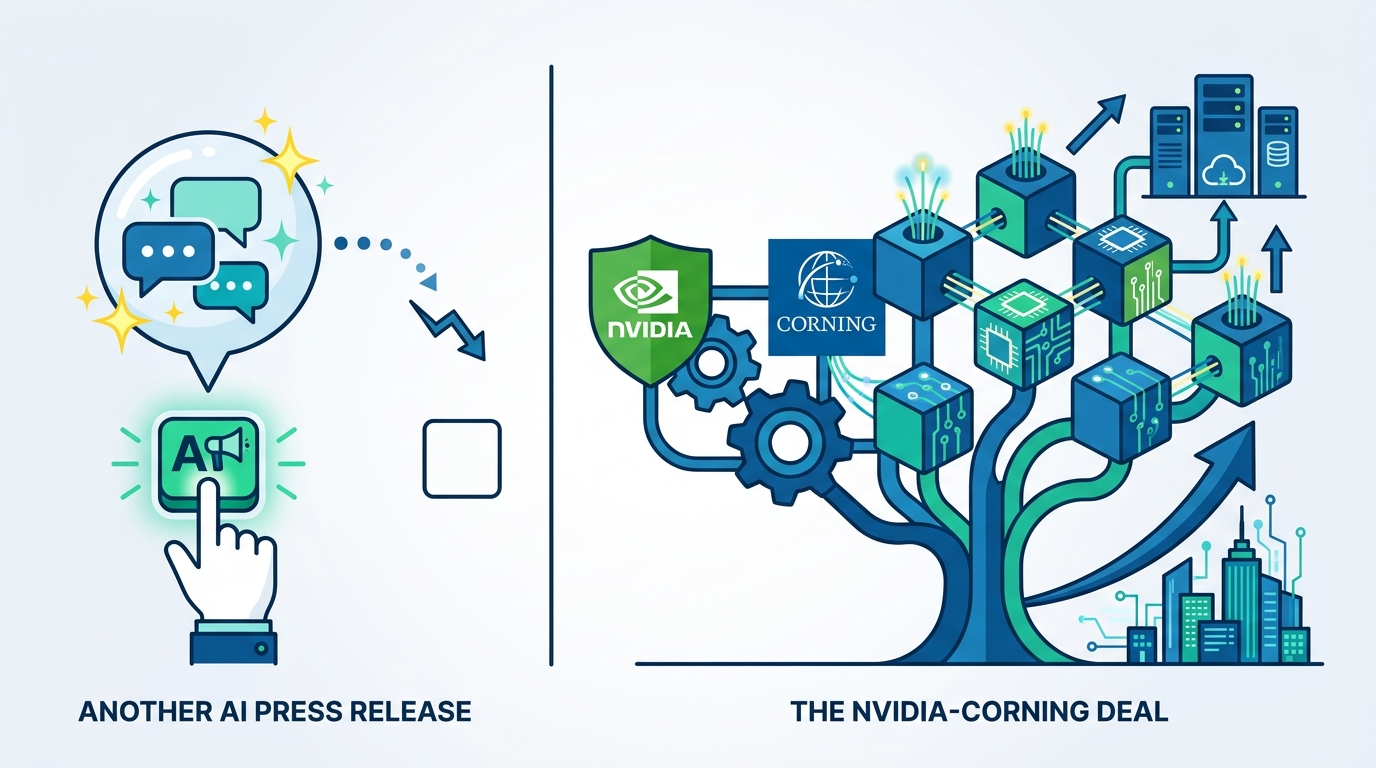
That objection is fair, but it misses the part that matters. No single partnership solves the entire AI supply chain, and it does not need to. The right question is whether this agreement addresses a real bottleneck with real capital and real capacity. It does. A 10x increase in optical connectivity manufacturing is specific, measurable, and tied to a known constraint in AI deployment. Even if the announcement is also good branding, the underlying investment is concrete. This is not empty symbolism; it is targeted industrial expansion.
What to do with this
If you are an engineer, PM, or founder, stop thinking about AI infrastructure as a GPU-only problem. The winners will design for the full stack: compute, networking, optics, power, cooling, and manufacturing lead times. If you are building for enterprise or cloud, pressure-test your roadmap against physical constraints, not just model benchmarks. If you are a founder, look for the overlooked layers where scale breaks first. That is where the next durable business will come from.
// Related Articles
- [IND]
WebX 2026 turns speaker hype into a conference brief
- [IND]
AI Weekly: 2026-07-06 ~ 2026-07-13
- [IND]
The AI Act should be treated as Europe’s operating system for AI
- [IND]
Booz Allen’s OpenAI Deal Is Real Advantage, Not Hype
- [IND]
OpenSearch’s vector search benchmark in 5 parts
- [IND]
Vector Databases That Work in Production