Why OpenAI’s Microsoft breakup is good for everyone
OpenAI’s move away from Microsoft exclusivity is the right call for customers, developers, and the market.

OpenAI’s move away from Microsoft exclusivity is the right call for customers, developers, and the market.
OpenAI and Microsoft have rewritten their deal so OpenAI can sell its products through any cloud, not just Azure, and that is the correct move. The old structure made one of the most important AI companies in the world look like a captive supplier inside a single infrastructure stack. The new structure keeps Azure as a priority partner, but it removes the choke point that turned distribution, pricing, and deployment into a negotiation with one gatekeeper.
Open access beats cloud lock-in
Get the latest AI news in your inbox
Weekly picks of model releases, tools, and deep dives — no spam, unsubscribe anytime.
No spam. Unsubscribe at any time.
When a model vendor is tied too tightly to one cloud, customers pay twice: once in product price and again in switching costs. Enterprises do not just buy inference, they buy procurement flexibility, regional coverage, compliance options, and bargaining power. If OpenAI can run on multiple clouds, buyers can compare latency, data residency, and cost instead of accepting whatever one platform offers.

This matters because AI usage is not a toy workload anymore. A startup shipping an agent, a bank handling regulated documents, and a consumer app serving millions all need different infrastructure choices. Multi-cloud availability turns OpenAI from a bundled feature into a real platform. That is healthier competition, and it is the only way to keep model providers from becoming extensions of the largest cloud vendor they happen to sign with first.
Competition will force better products
Exclusive distribution often protects complacency. If a model provider knows its default path is already locked in, it has less reason to optimize for portability, transparent pricing, and fast enterprise rollout. The revised agreement pushes OpenAI to compete on product quality rather than on contractual privilege. That pressure is overdue, because the market is no longer short of capable model vendors.
We already see what happens when alternatives exist. Anthropic, Google, and open-weight model ecosystems have made cloud choice part of the buying decision, not an afterthought. Developers compare context windows, tool use, latency, and deployment control across vendors. OpenAI staying tied to one cloud would have made it look weaker over time, not stronger, because the best AI products now win by being easy to adopt anywhere.
The market needs less gatekeeping, not more
Microsoft’s role as “primary cloud partner” is still meaningful, but it is no longer a veto over OpenAI’s future. That is important because the AI stack is already too concentrated. Chips are concentrated, cloud capacity is concentrated, and frontier model access is concentrated. Removing one layer of exclusivity does not solve the whole problem, but it does stop one company from controlling the route to market for a model that many developers now treat as infrastructure.
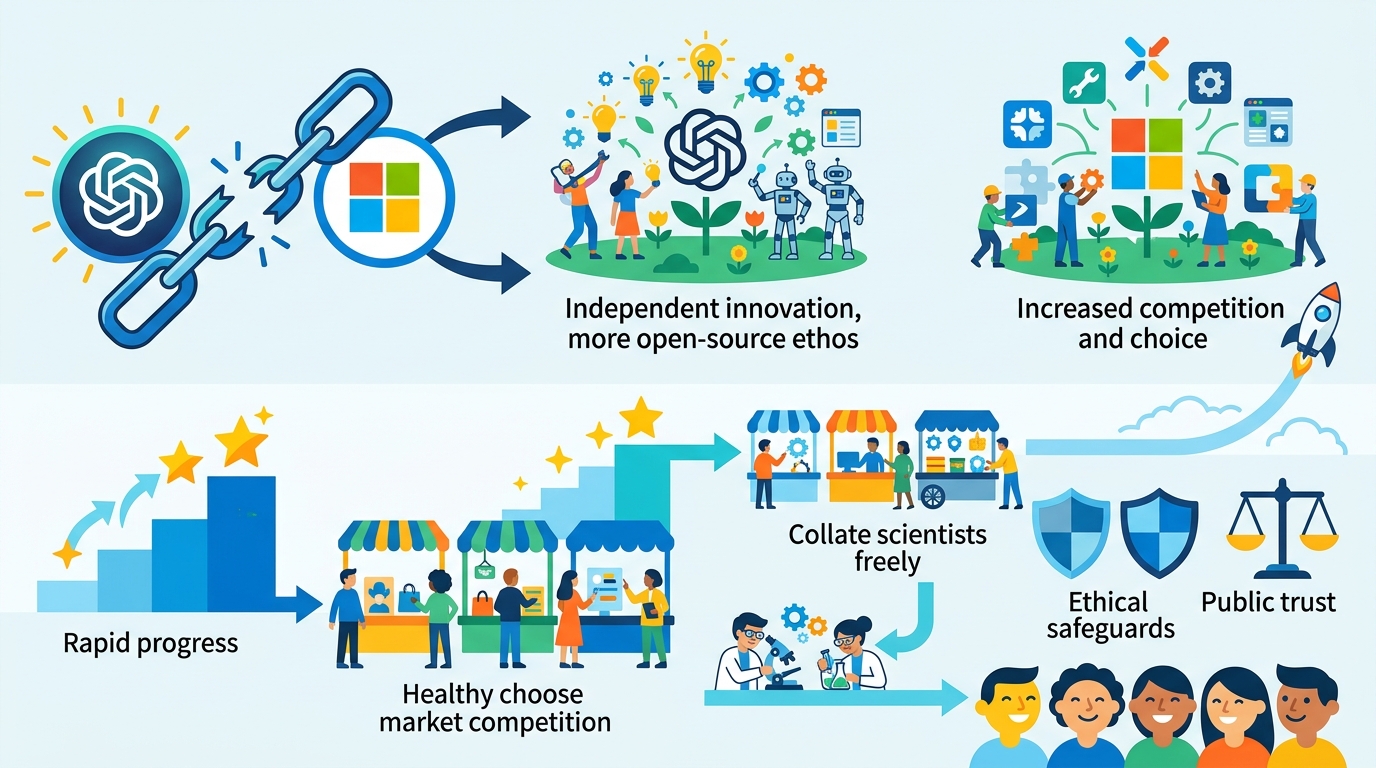
There is also a strategic benefit for the broader ecosystem. If OpenAI can move across clouds, other vendors will be forced to support portability, better interoperability, and more honest pricing. That helps customers and it helps regulators who are watching for anti-competitive bundling. The best outcome for the industry is not a single winner with a single distribution channel. It is a market where model quality, reliability, and economics decide who wins.
The counter-argument
Supporters of the old deal will say exclusivity gave OpenAI stability. One cloud partner can simplify operations, speed up deployment, and reduce the risk of fragmentation. They will also argue that Microsoft took the early risk, funded the buildout, and deserved preferential access in return. From that angle, loosening the contract looks like a betrayal of the partnership that helped OpenAI scale.
That argument has a real point: frontier AI is capital-intensive, and infrastructure certainty matters. But exclusivity was never the same thing as stability. It was dependency. OpenAI can still prioritize Azure while keeping the right to serve customers elsewhere, and that is the better trade. It preserves the benefits of a strong partnership without turning the partnership into a moat around the entire market.
What to do with this
Engineers and product teams should plan for model and cloud portability now, not later. Build abstraction around providers, keep deployment configs portable, and avoid hard-coding one vendor’s endpoints into critical paths. If you are a founder, treat cloud optionality as negotiating leverage. If you are a PM, make vendor independence part of your roadmap, because the companies that can switch fastest will buy better terms, ship faster, and survive the next round of platform reshuffling.
// Related Articles
- [IND]
WebX 2026 turns speaker hype into a conference brief
- [IND]
AI Weekly: 2026-07-06 ~ 2026-07-13
- [IND]
The AI Act should be treated as Europe’s operating system for AI
- [IND]
Booz Allen’s OpenAI Deal Is Real Advantage, Not Hype
- [IND]
OpenSearch’s vector search benchmark in 5 parts
- [IND]
Vector Databases That Work in Production