Why Rust developers should stop over-tooling their setup
Rust developers should keep their setup lean: a strong editor, AI help, voice input, and a structured shell are enough.

Rust developers should keep their setup lean: a strong editor, AI help, voice input, and a structured shell are enough.
Rust development does not need a sprawling toolchain, and the best setup in 2026 is a lean one that makes writing code faster, not more ceremonial. John Arundel’s workflow is a useful proof: Zed for editing, ChatGPT for review and explanation, Wispr Flow for input, Nushell for data work, and almost nothing else. That is not minimalism for its own sake. It is an argument that mature Rust tooling has already absorbed the jobs most developers used to outsource to plugins, shell hacks, and endless configuration.
First, Rust’s core tools already cover the basics
Get the latest AI news in your inbox
Weekly picks of model releases, tools, and deep dives — no spam, unsubscribe anytime.
No spam. Unsubscribe at any time.
The strongest case for a lean setup is that Rust itself now ships with a serious default stack. Arundel points out that rustup handles installation and updates, Cargo handles builds and dependencies, and rust-analyzer provides the language intelligence that once required a pile of editor extensions. That means the center of gravity has shifted: the language ecosystem, not the editor ecosystem, is now doing the heavy lifting.

That matters because every extra layer adds maintenance debt. A developer who spends an hour tuning plugins, debugging editor state, or keeping a local package zoo in sync is not improving code quality. They are paying a tax. Arundel’s refusal to use Homebrew is a telling example. He does not want “a million out-of-date and out-of-band packages cluttering up” his machine, and he is right to avoid that mess. A Rust workflow should be reproducible, fast, and boring in the best sense.
Second, AI and voice input are productivity tools, not ideology
The most useful part of Arundel’s setup is not Zed, but the way he uses AI. He does not hand code generation to ChatGPT and call it a day. He uses it to explain compiler errors, surface edge cases, and review finished code. That is the right division of labor. The human still owns the implementation, while the model acts as a second reader and an always-available tutor. For a language like Rust, where correctness and understanding matter more than raw output, that is a strong fit.
His voice workflow makes the same point from another angle. Wispr Flow is not a novelty in this setup; it is a force multiplier. Arundel uses it for email, chat, writing, and prompt entry, and he says it is faster than typing on a Mac and transformative on mobile. That is the real lesson: input method affects output quality. If speaking lets you draft more fluidly, communicate more often, and spend less time fighting a keyboard, then voice is not a gimmick. It is a better interface for thought.
The counter-argument
The opposing view is straightforward: this is a personal workflow, not a universal prescription. Some developers work in teams with strict standards, regulated environments, or security constraints that make AI tools hard to adopt. Others prefer Neovim, Emacs, or a highly customized VS Code environment because their muscle memory and shortcuts are already tuned to their hands. There is also a real risk of over-trusting AI explanations, especially when a model sounds confident about Rust ownership, lifetimes, or concurrency and gets the details wrong.
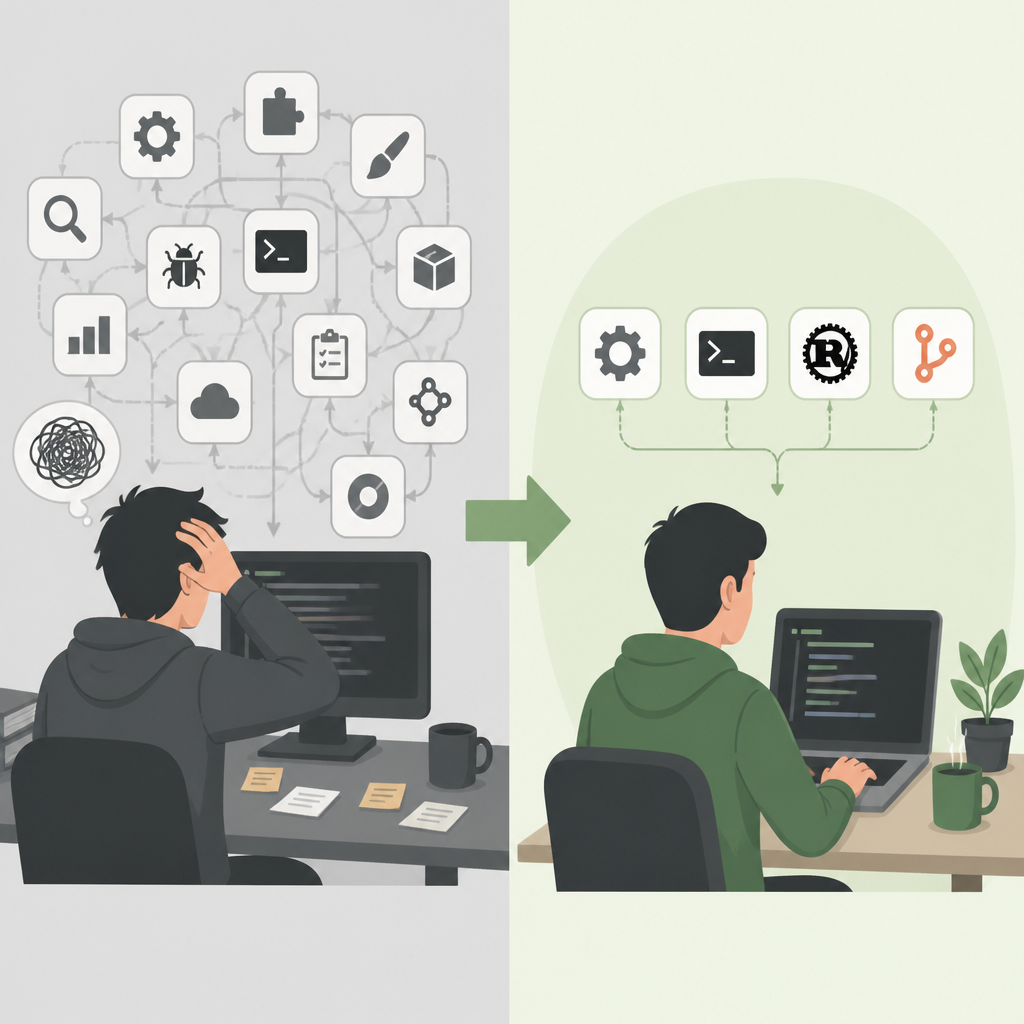
That criticism is valid, but it does not defeat the argument. A lean setup is not a ban on customization, and using AI does not mean surrendering judgment. Arundel’s workflow is explicitly human-led: he asks ChatGPT for explanation and review, then writes and verifies the code himself. That is the key boundary. The right standard is not “use these exact tools.” It is “stop accumulating tools that do not reduce friction.” If a plugin, package manager, or assistant does not make you faster or clearer, cut it.
What to do with this
If you are an engineer, audit your Rust setup for dead weight: keep one editor, one shell, one assistant, and one source of truth for tasks, then remove anything that only exists because you once had time to tinker. If you are a PM or founder, optimize for team speed, not tool fashion: standardize on the smallest stack that gets strong Rust support, lowers context switching, and leaves room for judgment. The goal is not a perfect setup. The goal is a setup that disappears while you build.
// Related Articles
- [TOOLS]
Nvidia and LG turn AI plans into a playbook
- [TOOLS]
Ollama is the best free AI path in 2026 for real work
- [TOOLS]
This MLOps list turns chaos into a stack
- [TOOLS]
BentoML turns model serving into Python APIs
- [TOOLS]
Magenta RealTime 2 lets you score in the DAW
- [TOOLS]
Open-source AI tools beat Claude’s paid tiers on value