420 Lines, 24 Hours, 4 Days: The Compression of AI Product Moats
Claude Design launched April 17, triggering a 7% drop in Figma's stock. Within 24 hours, its 420-line system prompt leaked from Pliny the Liberator. Within 4 days, an open-source MIT-licensed reimplementation appeared on GitHub at 1.7k stars and counting. The compression cycle reveals 2026's harsh reality: when prompts become moats, the moat lasts one day. Real differentiation now lives in model access, integrated UX, and distribution, not in the prompt itself.

On April 17, 2026, Anthropic Labs shipped Claude Design—a tool for collaborating with Claude to create polished designs, prototypes, slides, and one-pagers. Figma's stock dropped 6.8% to $18.84 that same day. Adobe followed. More intriguingly, three days before launch, Anthropic's chief product officer Mike Krieger quietly resigned from Figma's board. The market read it as pre-positioned chess.
The moat's shelf life proved shorter than expected. Within 24 hours of Claude Design going live, a 420-line system prompt leaked from a user known as Pliny the Liberator. It revealed the core: Opus 4.7, a six-step workflow, an anti-AI-look checklist, and a dual-agent verification loop, all encoded as plain text instructions.
One Day to Leak
Get the latest AI news in your inbox
Weekly picks of model releases, tools, and deep dives — no spam, unsubscribe anytime.
No spam. Unsubscribe at any time.
The leaked prompt exposed these technical choices: dynamic role-switching (designer, animator, slide maker) based on task type; oklch color space over HSL for perceptual uniformity; a "one thousand nos for every yes" aesthetic principle straight from Steve Jobs; and most intriguingly, a two-agent verification loop where a second agent independently validates screenshots, layout, and JavaScript errors in a sandboxed iframe, avoiding self-confirmation bias.

None of this is novel in principle. Designers and engineers knew oklch beat HSL, minimalism beat clutter, peer review beat self-review. Claude Design's breakthrough was operationalizing these as a unified, Opus-4.7-powered process. The complete blueprint leaked in 24 hours.
Four Days to Rewrite
The open-source response was faster. Within four days, developer ConardLi published garden-skills, an MIT-licensed Skill collection now at 1.7k GitHub stars. Beyond copy-pasting the leaked prompt, this reimplementation added real improvements: explicit design system declarations in Markdown upfront; a "v0 half-baked" strategy prioritizing minimal viable layouts with visible assumptions before full builds; expanded anti-cliché checks (no fake customer logos, no fabricated review counts, no data-stuffing); mandatory placeholder philosophy (placeholders signal "real material needed," fakes signal "I'm phoning it in"); and a color-font pairing reference table covering editorial, luxury, consumer, minimalist, and artisan aesthetics.
The rewrite also corrected original constraints: no inline style objects (preventing namespace collisions), no cross-script scope sharing, no scrollIntoView in iframes. This was four days of engineering validation and hardening, not plagiarism.
Where the Real Moat Lives
This 24-hour leak, four-day rewrite cycle raises a sharp question: if system prompts are your moat, how long does that moat last?
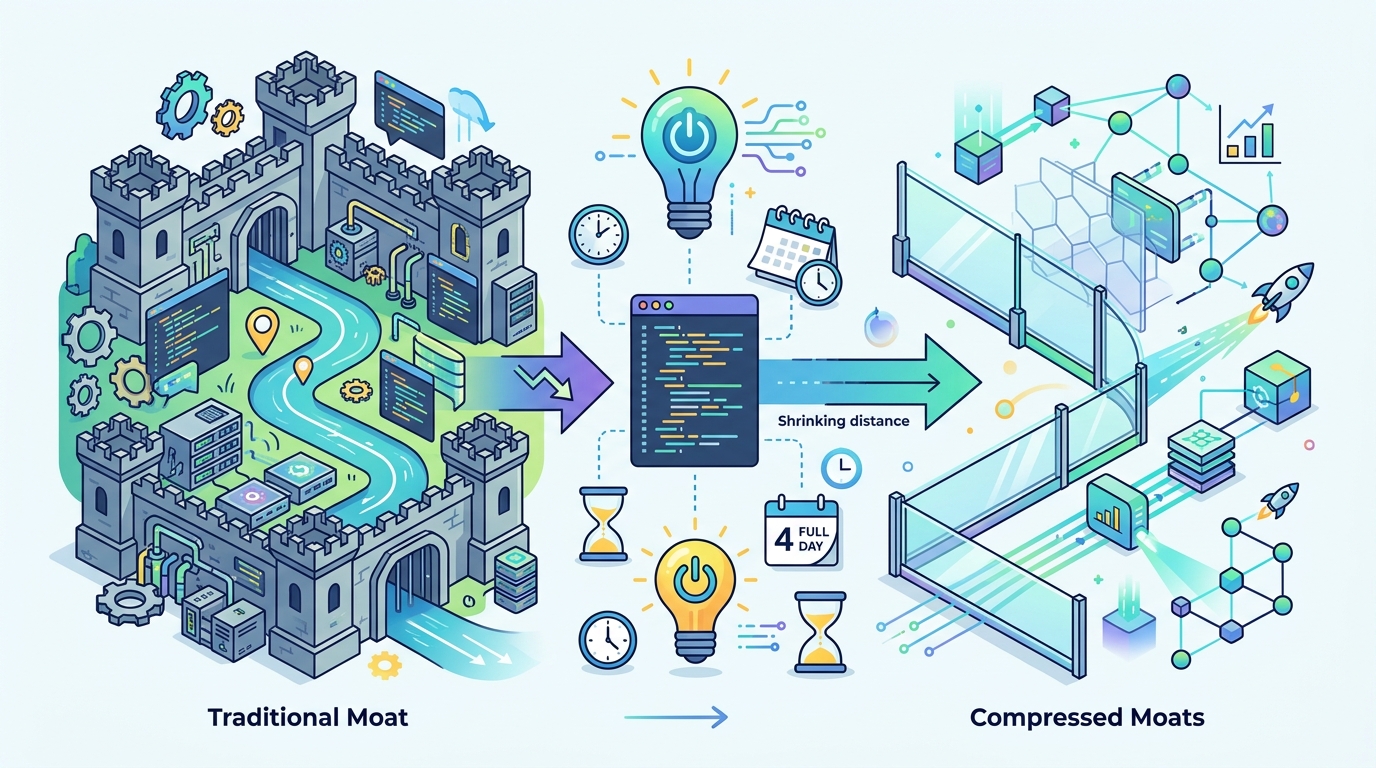
Anthropic's actual product is not Opus 4.7 plus 420 lines of prompt. It is integrated: Canvas UI plus iframe sandboxing, sub-agent verification loops, Pro/Max/Team subscription tiers, native integration into Claude.ai's ecosystem. The real moat is the model itself, the integrated user experience, and distribution baked into Anthropic's subscription funnel.
But the open-source community just proved the inverse: when core intelligence becomes encodable as prompts, shelf life equals leak-to-public time. Typically hours. Then the work is engineering and optimization, the community's forte.
This is the 2026 pattern. Last week, Karpathy's LLM Wiki Gist materialized as a desktop app in three weeks, hitting 4.4k stars. This week, Claude Design's prompt became open-source MIT in four days. The cycle compresses weekly. For Anthropic, Figma, Adobe, and the entire AI tooling ecosystem, the question is no longer "will prompts leak?" but "how do we operate in a world where they always do?"
// Related Articles
- [TOOLS]
OpenClaw with Ollama turns Telegram into a bot
- [TOOLS]
Aliyun Bailian Token Plan turns credits into agents
- [TOOLS]
One API gateway turns six AI APIs into one
- [TOOLS]
OpenAI FDEs turn broken agents into shipped systems
- [TOOLS]
Anthropic’s daily brief turns news into a workflow
- [TOOLS]
Claude Reflect turns usage into retention