ML Conferences Tracker for Deadlines and Papers
A GitHub notebook tracks ML conference dates, deadlines, and accepted papers for ICML, NeurIPS, ICLR, CVPR, ACL, and more.
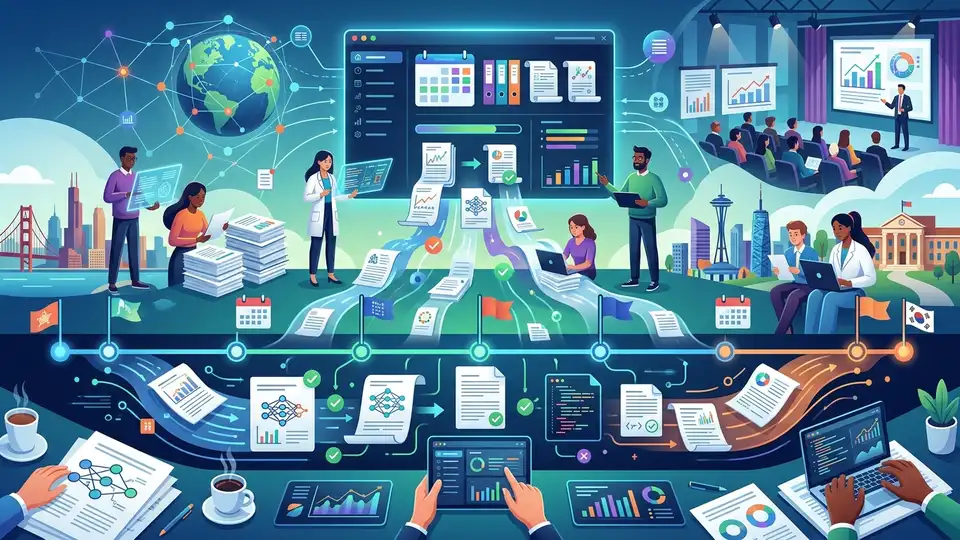
If you follow machine learning conferences, timing matters almost as much as the paper itself. The khairulislam/ML-conferences repository keeps a running notebook of deadlines, event dates, and accepted paper lists for major venues, with 216 stars and 16 forks as of the snapshot in the README.
That may sound simple, but for researchers and engineers, a clean calendar can save weeks of confusion. Instead of bouncing between conference sites, you get one place to check ICML, NeurIPS, ICLR, and a long list of other venues.
A practical index for ML deadlines
Get the latest AI news in your inbox
Weekly picks of model releases, tools, and deep dives — no spam, unsubscribe anytime.
No spam. Unsubscribe at any time.
The repo is built like a reference notebook, not a flashy web app. That is part of its appeal. It collects the dates people actually need: submission deadlines, conference windows, locations, homepage links, and, where available, accepted paper lists.
The README groups conferences by area, which makes the file useful for more than one audience. Applied ML folks can jump to CVPR or ACL, while systems researchers can check MLSys or ASE. Data mining people get KDD, CIKM, and PAKDD.
- 216 GitHub stars and 16 forks in the current snapshot
- Written in Jupyter Notebook, which makes the data easy to inspect and update
- Tracks both deadlines and accepted paper lists, not just event dates
- Covers ML, data mining, vision, NLP, and software engineering venues
- Includes recent conference status labels such as Open, Closed, and TBD
The recent-conferences table is the part most people will check first. It includes 2025 and 2026 events with location, deadline, homepage, and status. For example, ICML 2026 is listed for July 6 to 12 in Seoul, with a Jan. 28, 2026 deadline and an Open status.
That same table also shows how quickly the academic calendar fills up. IJCAI 2026 is in Bremen in August, MICCAI 2026 is in Abu Dhabi in October, and KDD 2026 lands in Jeju in August. If you are trying to plan a submission strategy, that kind of overview is worth more than a dozen bookmarks.
Why this notebook is useful to working researchers
Conference deadlines are not trivia. They shape experiments, writing schedules, internal review cycles, and even hiring timelines for labs and startups. A repo like this helps teams compare venues without re-reading every call for papers from scratch.
The accepted-paper angle matters too. It gives readers a way to look at what each conference actually published in a given year. That makes the repo useful for topic scouting, trend spotting, and figuring out where a project might fit before a submission is even drafted.
"The best way to predict the future is to invent it." — Alan Kay
Alan Kay’s line gets quoted a lot because it fits research culture so well. In ML, the people who keep close track of deadlines and accepted papers are often the same people deciding where the next big idea should be sent.
This repository does that administrative work for them. It is not trying to rank conferences or judge paper quality. It simply makes the publication process easier to understand, which is a real service in a field where dates move fast and submission windows are short.
The notebook format also means the project is easy to extend. Contributors can add new rows, update deadlines, or patch links without redesigning a full site. For a community-maintained reference, that matters more than polish.
How it compares with official conference sites
Official conference pages are the source of truth, but they are rarely pleasant to compare side by side. One site may highlight the full schedule, another may bury the paper deadline, and a third may move the CFP page after the first review cycle. This repo tries to normalize that mess into one table.
That matters because the major ML conferences do not share the same calendar rhythm. ICML 2025 ran July 11 to 19 in Vancouver, NeurIPS 2025 ran Dec. 2 to 7 in San Diego, and ICLR 2025 happened Apr. 24 to 28 in Singapore. Those date gaps are big enough to shape how teams batch experiments and write papers.
- ICML 2026: July 6-12, Seoul, deadline Jan. 28, 2026, Open
- IJCAI 2026: Aug. 15-21, Bremen, deadline Jan. 19, 2026, Open
- MICCAI 2026: Oct. 4-8, Abu Dhabi, deadline Feb. 26, 2026, Open
- KDD 2026: Aug. 9-13, Jeju, deadline Feb. 8, 2026, Open
- CVPR 2026: June 6-12, Denver, deadline Nov. 13, 2025, Closed
- ICCV 2025: Oct. 19-25, Honolulu, deadline Mar. 7, 2025, Closed
There is also a nice historical value in the archive tables. The ICML section goes back to 2008, and the NeurIPS section includes multiple years from 2017 onward. That makes the repo useful for anyone studying how venues move across continents, how deadlines shift, or how the field’s center of gravity changes over time.
One small detail tells you a lot about the project’s intent: it links to DBLP for some conference histories. DBLP is a trusted academic index, so pairing it with the repo’s own tables gives readers both convenience and traceability.
A lightweight tool with real value
What makes ML-conferences worth keeping around is that it solves a boring problem well. Researchers do not need another opinionated dashboard; they need a dependable list they can skim in a minute, then trust enough to plan a submission around.
It is also a good example of how a simple notebook can become infrastructure for a community. The repo sits somewhere between a personal cheat sheet and a public utility, and that middle ground is exactly why it works.
If the maintainer keeps updating the recent-conferences table and adding accepted-paper links, this notebook could become the first tab many ML authors open during conference season. The real test is whether the community keeps contributing updates when dates shift, CFP pages move, and new venues join the rotation.
For now, the takeaway is simple: if you care about where to submit next, bookmark this repo alongside the official sites. Then ask yourself one practical question before your next draft cycle begins: is your target venue open, or are you already late?
// Related Articles
- [TOOLS]
Aliyun Bailian Token Plan turns credits into agents
- [TOOLS]
One API gateway turns six AI APIs into one
- [TOOLS]
OpenAI FDEs turn broken agents into shipped systems
- [TOOLS]
Anthropic’s daily brief turns news into a workflow
- [TOOLS]
Claude Reflect turns usage into retention
- [TOOLS]
Midjourney turns prompt ideas into art