Superpowers vs Everything Claude Code: Which Should You Pick
A deep-dive comparison reveals that Claude Code's two most popular workflow plugins serve different needs. Superpowers emphasizes documentation-driven development and control, while Everything Claude Code leverages context management and agent orchestration. Your choice depends on project scale and your Claude model tier.
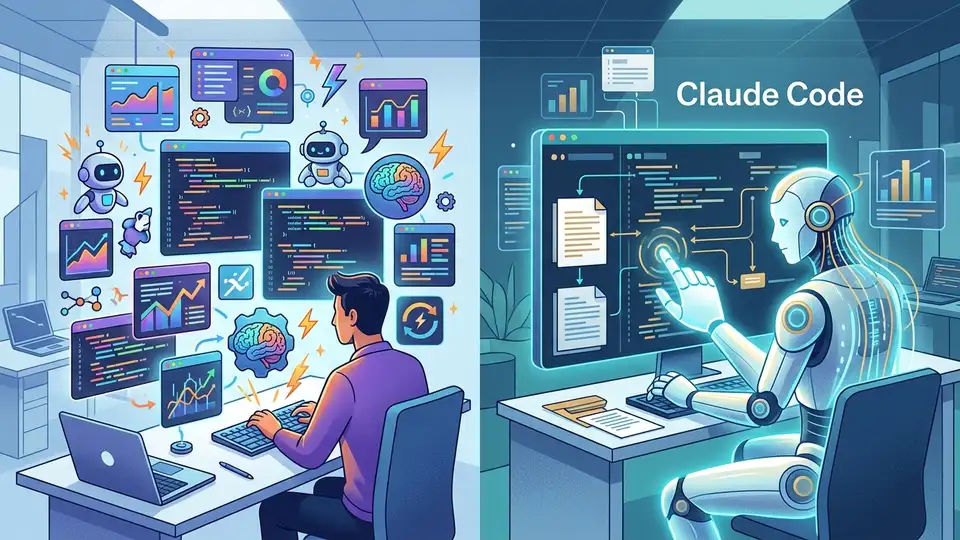
Choosing the wrong workflow plugin for Claude Code can cut your productivity in half. The two most popular extensions right now — Superpowers and Everything Claude Code — both look impressive, but they solve completely different problems. One takes a document-first approach, the other goes all-in on context management. Understanding the difference before committing saves you real time.
Superpowers: Disciplined, Traceable Development
Get the latest AI news in your inbox
Weekly picks of model releases, tools, and deep dives — no spam, unsubscribe anytime.
No spam. Unsubscribe at any time.
Superpowers, built by Jesse Vincent, operates on a straightforward principle: let documents drive Claude's decisions. It bakes in best practices like brainstorming, Git Worktrees, TDD, code review, and debugging workflows into the plugin itself.
Why is this design clever? It forces clarity. Every decision, every test gets documented. When you need to debug later, you can immediately trace the "why" behind each choice. In testing, complex bugs typically require only 2-3 iterations with full traceability. Compare that to debugging without context — you're flying blind.
Another win: context isolation. Git Worktrees keep feature branches compartmentalized, so changing Feature A doesn't accidentally break Feature B. For mid-to-large codebases, this is game-changing.
One more thing — it doesn't demand cutting-edge models. Claude 3.5 Sonnet does the job fine. You don't need to pay for Claude 4 tier pricing.
- Controllability: Excellent — every decision backed by documentation
- Stability: Excellent — complex bugs fixed in 2-3 rounds
- Learning curve: Moderate — requires building documentation habits
- Model requirements: Standard — Claude 3.5+ works fine
Everything Claude Code: Speed and Breadth
Everything Claude Code, created by afnan-m, takes the opposite approach. Ten months of real-world iteration resulted in 15+ Agents, 30+ Skills, and 20+ Commands. It's basically every workflow pattern you could imagine, bundled together.
Where does it shine? Codebase exploration at scale. You can parallelize across multiple dimensions simultaneously. On smaller projects with a capable model, you'll move at light speed.
Here's the catch: it has hard requirements on model tier. Claude 4.5+ is strongly recommended. The system relies on the model having enough reasoning capacity to orchestrate 15+ agents coherently. Use a weaker model and you'll get agents stepping on each other's toes — not fun.
Plus, context management becomes your bottleneck. Token costs spike faster. Debugging gets messier because you're juggling more moving parts than with Superpowers. Traceability suffers.
- Speed: Excellent — multi-dimensional parallel development
- Codebase exploration: Excellent — AI scans the entire codebase automatically
- Stability: Good — may struggle with requirement jumps on large projects
- Model requirements: High — Claude 4.5+ recommended
Which Should You Actually Use?
Our recommendation: start with Superpowers. It's predictable, stable, and doesn't depend on model tier to be effective. Even with Claude 3.5, you get development speed that rivals using 4.5 with Everything Claude Code.
Everything Claude Code is powerful, but it's more for people who've already mastered AI-assisted development with Claude Code. If you're still figuring out workflows, its complexity becomes a liability rather than a feature.
- Mid-to-large project, predictability first: Superpowers
- Fast iteration cycles, strong model available: Everything Claude Code
- Starting out, unsure: Superpowers
Can You Use Both?
These workflows don't have to be mutually exclusive. Many sophisticated projects adopt hybrid strategies: core business modules use Superpowers for stability and traceability, while experimental features and peripheral tools use Everything Claude Code for rapid iteration. This balances core stability with innovation flexibility.
Both tools keep evolving, and both have active communities. The real question is: what's your actual bottleneck in AI-assisted development? Answer that honestly, and the right tool becomes obvious. Following hype is just wasted tokens and frustration.
// Related Articles
- [TOOLS]
Aliyun Bailian Token Plan turns credits into agents
- [TOOLS]
One API gateway turns six AI APIs into one
- [TOOLS]
OpenAI FDEs turn broken agents into shipped systems
- [TOOLS]
Anthropic’s daily brief turns news into a workflow
- [TOOLS]
Claude Reflect turns usage into retention
- [TOOLS]
Midjourney turns prompt ideas into art