TurboQuant, Fast Cold Starts, and Rust on GPUs
TurboQuant cuts KV cache use 4.6x, GPU state restoration slashes cold starts, and Rust is moving deeper into CUDA work.

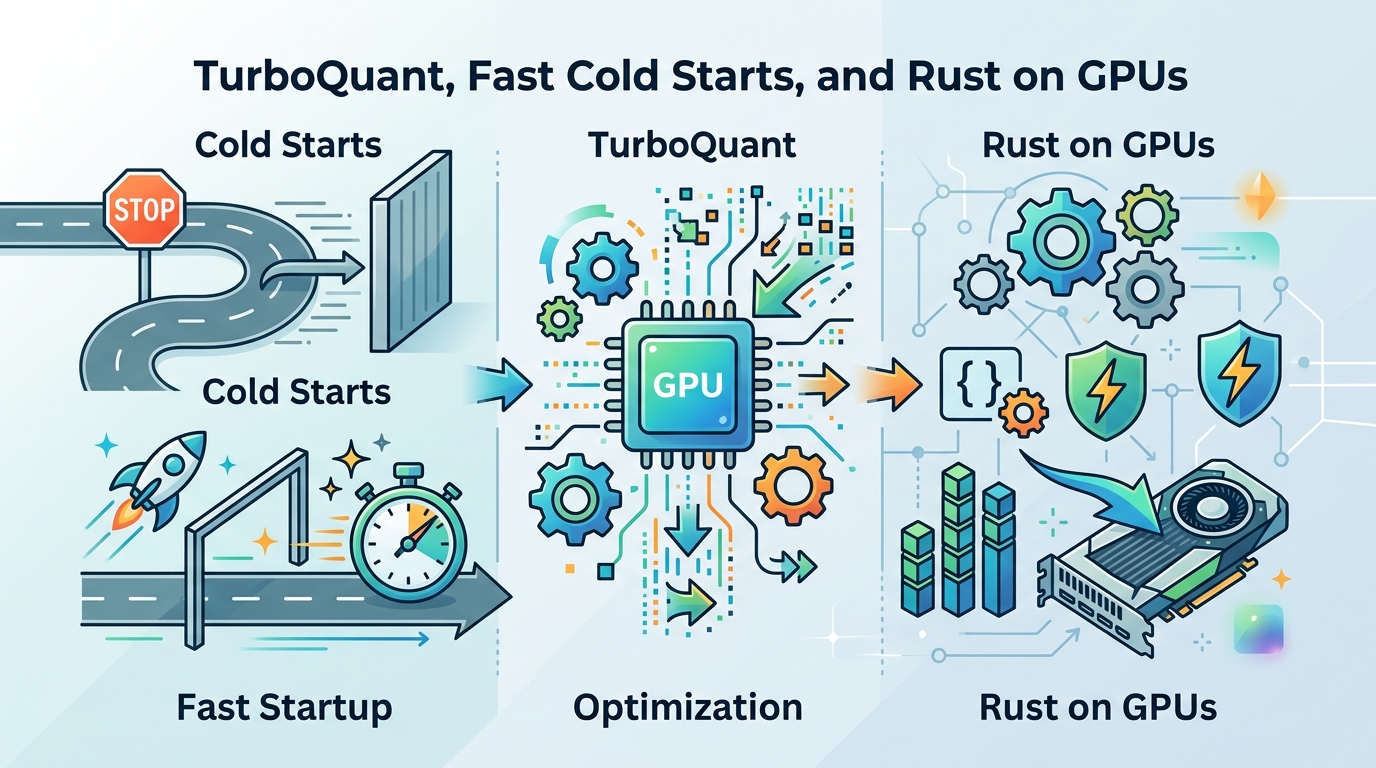
Local LLM inference is getting more practical in a very concrete way: TurboQuant claims 4.6x KV cache compression, while one GPU state-restoration approach targets sub-second cold starts for 32B models. Add Rust entering CUDA work, and the people building local AI systems suddenly have better options for memory, latency, and safety.
That mix matters because the bottlenecks are easy to name. Long context windows eat VRAM, cold starts make serverless inference feel clumsy, and custom GPU code is still too easy to break in C++.
TurboQuant trims the KV cache problem
Get the latest AI news in your inbox
Weekly picks of model releases, tools, and deep dives — no spam, unsubscribe anytime.
No spam. Unsubscribe at any time.
The first story comes from MLX work discussed in the r/LocalLLaMA community. The headline number is simple: 4.6x KV cache compression using TurboQuant-style methods and custom Metal kernels on Apple Silicon.

For anyone who has tried to run a larger model locally, the KV cache is where context length starts to hurt. Once prompts get long, memory pressure rises fast, and the model stops feeling roomy. Compressing that cache by more than four times changes the math for long chats, RAG pipelines, and multi-turn agent loops.
The report also claims 98% of FP16 inference speed. That matters more than the compression ratio alone. A smaller cache is nice, but if throughput collapses, the trade is bad. Here, the pitch is that memory drops sharply without turning inference into a crawl.
- KV cache compression: 4.6x
- Inference speed retained: 98% of FP16
- Target environment: Apple Silicon with Metal kernels
- Model example: Qwen 32B
There is a practical angle here for developers building local assistants. A 32B model that fits more comfortably in memory can handle longer prompts, larger batch sizes, or more concurrent sessions before hitting the ceiling.
This also points to a broader shift in local inference work. The bottleneck is less about raw parameter count and more about memory management around attention and context. TurboQuant attacks the part that usually gets ignored until the first out-of-memory error.
Cold starts are getting attacked at the GPU state level
The second item is about one of the most annoying problems in inference systems: the cold start. In serverless setups, or any environment where models sleep between requests, startup latency can ruin the first user experience. The approach described in the source aims for sub-second cold starts for 32B models by restoring GPU state instead of rebuilding everything from scratch.
That is a very different mental model from the usual load-and-initialize flow. Instead of reading weights, setting up the CUDA context, preparing kernels, and allocating cache structures every time, the idea is to snapshot the GPU state and bring it back quickly when needed.
"The future of serverless computing is not about just spinning up more containers, but about efficiently restoring the exact state of a service." — Matt Ranney, co-founder and CTO of Fastly
Ranney’s point maps neatly onto this GPU work. If the state of a model can be preserved and restored, then the first token after idle time stops feeling like a penalty. For self-hosted systems, that means fewer awkward pauses. For dynamic deployments, it means model switching becomes much less painful.
The source does not name a production framework here, but the implications are easy to see for tools like vLLM and other inference servers. A fast restore path can make local services feel closer to always-on cloud APIs without keeping everything hot all the time.
- Target model size: 32B parameters
- Goal: sub-second cold starts
- Method: restore GPU state instead of full reinitialization
- Main benefit: faster first response after idle periods
There is still a big engineering question underneath this idea: how portable is the snapshot, and how much GPU-specific plumbing is required? If the answer is “a lot,” adoption will stay narrow. If the restore path can be generalized, this could become a standard trick for latency-sensitive inference.
Rust keeps moving into GPU code
The third item is smaller on paper but important in practice: Rust is showing up in CUDA work, including threads on the GPU. That matters because GPU programming still leans heavily on C and C++, where memory bugs can hide inside highly parallel code and take forever to track down.
Rust changes the tradeoff. Its ownership model and borrow checker catch a lot of mistakes before code runs. That does not make GPU programming easy, but it does make custom kernel work less fragile, which is a big deal when you are writing code for quantization, attention, or pre/post-processing around LLMs.
For teams that care about performance and reliability, this is a good fit. Rust can keep the low-level control developers need while reducing the chance of a nasty runtime bug in a critical path. That matters even more when the code is part of a local AI stack that you want to trust on your own hardware.
It also opens the door to better maintainability. A lot of GPU projects become hard to touch after the first optimization pass. Rust may not remove that complexity, but it can make the codebase easier to reason about when several people are working on custom kernels.
- Traditional GPU kernel languages: C and C++
- Rust advantage: compile-time memory safety checks
- Best fit: custom CUDA kernels for LLM internals
- Likely use cases: quantization, attention, and data movement code
For anyone building local inference systems, this is a reminder that the stack is widening. You can now think about memory compression, startup latency, and kernel safety in one pass instead of treating them as separate problems.
What this means for local AI builders
Put the three stories together and the direction is clear: local LLM work is becoming less about squeezing a model into a GPU at all costs, and more about making the whole runtime smarter. TurboQuant reduces memory pressure, GPU state restoration attacks startup latency, and Rust gives kernel authors a cleaner way to write low-level code.
That combination matters for people running RAG systems, agent workflows, or private assistants on their own machines. A model that fits better, starts faster, and is easier to extend is a model you can actually use every day.
If these techniques keep moving from demos into production code, the next big question is simple: which inference stack will adopt them first at scale? My bet is on the projects that already care about developer ergonomics and GPU efficiency, because they have the most to gain from every extra byte saved and every second cut from startup time.
For more on inference tooling and local AI systems, see our related coverage on local LLM inference tools and Rust in AI infrastructure.
// Related Articles
- [TOOLS]
Aliyun Bailian Token Plan turns credits into agents
- [TOOLS]
One API gateway turns six AI APIs into one
- [TOOLS]
OpenAI FDEs turn broken agents into shipped systems
- [TOOLS]
Anthropic’s daily brief turns news into a workflow
- [TOOLS]
Claude Reflect turns usage into retention
- [TOOLS]
Midjourney turns prompt ideas into art