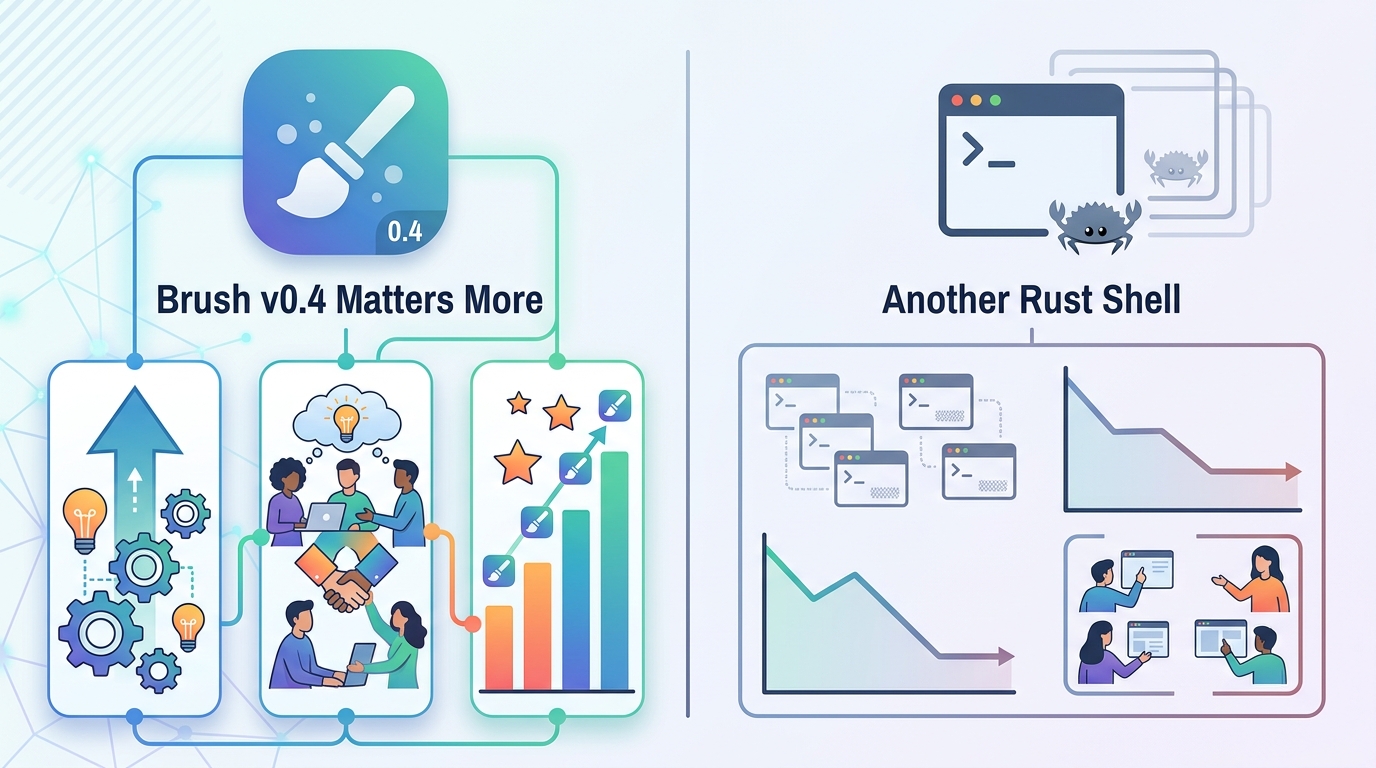
Why Brush v0.4 Matters More Than Another Rust Shell
Brush v0.4 matters because it turns a Rust shell into a credible Bash/POSIX alternative.
Brush v0.4 turns a Rust shell into a credible Bash/POSIX alternative.
Brush v0.4 is important because it crosses the line from hobby shell to serious daily driver: it adds major Bash behavior like set -e, set -u, pipefail, failglob, the ERR trap, and coprocesses, while also fixing ugly edge cases around closed pipes, broken stdout, non-UTF8 history files, and odd file-descriptor states. That is the difference between a demo and a tool people can trust at login, in scripts, and across platforms.
Brush is finally chasing compatibility, not novelty
Get the latest AI news in your inbox
Weekly picks of model releases, tools, and deep dives — no spam, unsubscribe anytime.
No spam. Unsubscribe at any time.
The biggest reason to care about Brush v0.4 is that it stops asking users to adapt to the shell and starts adapting to the shell users already know. Bash compatibility is the whole game for a replacement shell, and Brush now implements or expands the behaviors that make scripts predictable instead of fragile. If set -e and pipefail do not work the way users expect, every promise about “modernizing” the shell is hollow.
That matters because shell migration fails on tiny mismatches, not grand design flaws. One broken trap, one different failure rule, one weird pipe behavior, and a script that worked for years becomes a support ticket. Brush v0.4 shows the developers understand this reality by focusing on language semantics and failure handling rather than cosmetic improvements or benchmark theater.
Rust matters here because shells fail in the margins
Brush v0.4’s other meaningful advance is robustness. Handling closed pipes, broken stdout, unusual file-descriptor states, and non-UTF8 history files sounds unglamorous, but that is exactly where shells earn or lose trust. A shell is not judged when everything is normal; it is judged when the terminal is half-broken, the pipeline is weird, or the environment is hostile.
The move to make Brush usable as a login shell on macOS reinforces that point. Login shells sit at the center of a user’s environment, so stability is not optional. A Rust implementation does not automatically guarantee correctness, but it does give Brush a strong foundation for memory safety and defensive error handling. In a category where crashes and undefined behavior are unacceptable, that architectural choice is a real advantage.
Cross-platform support is the real test, not the Rust label
Brush v0.4 also improves path handling on Windows and gets FreeBSD and Android building cleanly again. That is not a side note. Most shells claim portability, then quietly depend on Unix assumptions that collapse the moment the platform changes. Brush is trying to be a shell that survives contact with more than one operating system, and that is a harder engineering problem than merely compiling on another target.
The practical value is clear: a shell that behaves consistently across macOS, Windows, FreeBSD, and Android becomes useful to developers who move between environments. The Rust pitch only matters if it produces fewer platform-specific footguns. Brush v0.4 is interesting because it shows the project is aiming at real portability, not a Rust-flavored clone of Bash that only works on one machine.
The counter-argument
The skeptical view is strong: shell users do not need another shell, they need Bash, POSIX sh, or zsh to keep working. Compatibility projects often spend years chasing edge cases while never fully escaping the shadow of the incumbent. From that angle, Brush is just another reimplementation with a long tail of missing features, and the market already has enough shells that are “almost ready.”
That criticism is fair in one respect: Brush will be judged by compatibility debt, and it is still early. But the rebuttal is simple. If a shell is written in Rust, aims for Bash/POSIX compatibility, and is already fixing the exact class of bugs that break real workflows, then it is not wasting time on novelty. It is building the minimum credible foundation for a safer, more portable replacement. The burden is on Brush to keep shipping, but v0.4 proves the project is solving the right problems.
What to do with this
If you are an engineer, do not treat Brush as a curiosity. Test it against the scripts that matter most: failure handling, traps, pipes, login shell behavior, and platform-specific startup paths. If you are a PM or founder, the lesson is sharper: infrastructure tools win trust by eliminating edge-case failures before they advertise features. Brush v0.4 is a reminder that in systems software, reliability is the product, and compatibility is the proof.
// Related Articles
- [TOOLS]
OpenClaw with Ollama turns Telegram into a bot
- [TOOLS]
Aliyun Bailian Token Plan turns credits into agents
- [TOOLS]
One API gateway turns six AI APIs into one
- [TOOLS]
OpenAI FDEs turn broken agents into shipped systems
- [TOOLS]
Anthropic’s daily brief turns news into a workflow
- [TOOLS]
Claude Reflect turns usage into retention