Why Claude Opus 4.7 is the right model for Copilot now
Claude Opus 4.7 should replace older Copilot models because it handles long, tool-heavy coding tasks better.

Claude Opus 4.7 is a better Copilot model for long, tool-heavy coding work.
GitHub is right to put Claude Opus 4.7 in Copilot and phase out Opus 4.5 and 4.6. The release notes point to stronger multi-step task performance, more reliable agentic execution, and better long-horizon reasoning in complex workflows. That is exactly what matters when an AI assistant is not just autocomplete, but a tool-using collaborator that has to read context, plan, call functions, and finish the job without drifting off course.
Long-horizon coding is the real benchmark
Get the latest AI news in your inbox
Weekly picks of model releases, tools, and deep dives — no spam, unsubscribe anytime.
No spam. Unsubscribe at any time.
The biggest mistake in model selection is overvaluing short, flashy demos. Writing a tidy function or answering a syntax question is not the hard part. The hard part is keeping state across many steps: inspect the repo, infer the bug, edit the right files, run the right commands, notice the failed test, and recover without losing the thread. GitHub says Opus 4.7 is better at multi-step task performance, and that is the metric that should decide which model sits in Copilot by default.

There is a reason GitHub framed this launch around agentic execution and tool-dependent workflows. Copilot is increasingly used in IDEs, CLI flows, cloud agents, pull request review, and mobile surfaces. In those environments, a model that is merely clever is not enough. A model must be dependable under interruption, context loss, and layered instructions. If Opus 4.7 reduces the number of times a session derails, it is not a marginal upgrade. It is a product-quality improvement.
Model sprawl hurts users more than it helps them
GitHub also says it is streamlining its model offerings and replacing Opus 4.5 and 4.6 over time. That is the correct move. Too many similar models in a picker create decision fatigue, inconsistent outcomes, and endless internal debate over which one is “best” for a given task. For most developers, the cost of choosing wrong is higher than the value of having three near-adjacent options. A clearer default is a better product.
The rollout details reinforce that point. Opus 4.7 is being made available across Copilot Pro+, Business, and Enterprise, with gradual rollout and admin controls for enterprise plans. That is a sane distribution model for a premium capability. GitHub is not pretending every team needs to manually curate a model stack. It is saying the platform should absorb that complexity and expose a stronger default, while still giving administrators policy control where governance matters.
Premium pricing is justified when the model saves real labor
GitHub launched Opus 4.7 with a 7.5x premium request multiplier, later updated to 15x after the promotional window. That sounds steep until you compare it with the cost of a failed agent loop. A model that burns time by making partial edits, missing dependencies, or wandering through the wrong files can easily cost more than a premium request in engineer hours. In that sense, the pricing is not about raw token economics. It is about whether the model is reliable enough to replace repeated human correction.
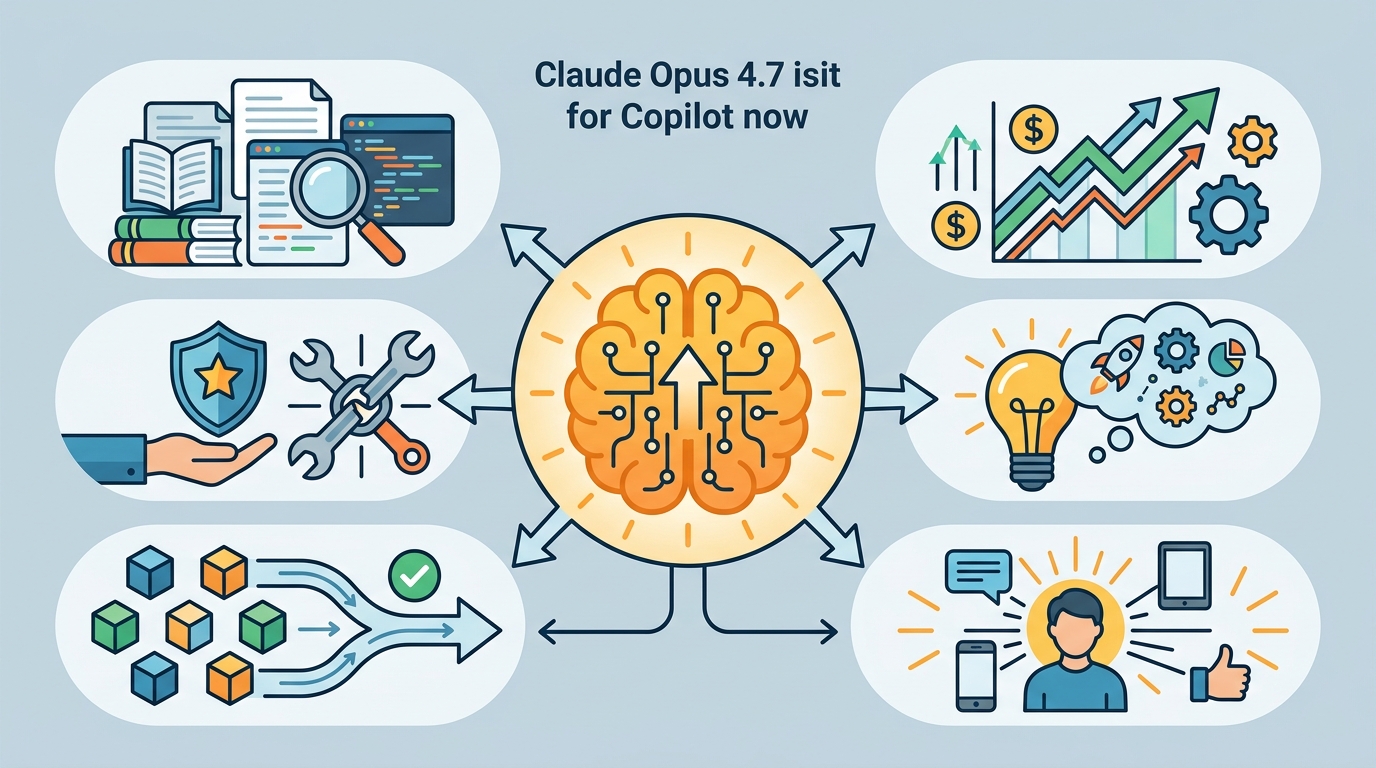
This is where Copilot has to be judged as infrastructure, not novelty. If a team uses the model for code generation, refactoring, PR assistance, and cloud agent tasks, then a better success rate compounds across the workflow. One fewer broken iteration in a 20-step task is meaningful. One fewer false start in a release-critical change is meaningful. GitHub’s own benchmark language suggests Opus 4.7 clears that bar, which makes the higher premium defensible for users who value throughput over bargain hunting.
The counter-argument
The strongest objection is that premium frontier models can overfit to benchmark wins and still disappoint in day-to-day use. Teams care about latency, cost predictability, and consistency across a broad codebase, not just headline reasoning scores. There is also a legitimate worry that replacing multiple models with one “best” option narrows choice and pushes users into a one-size-fits-all workflow. For smaller tasks, a lighter model can be cheaper and fast enough.
That critique is fair, but it does not defeat GitHub’s move. Copilot is not a research lab where model diversity is the goal. It is a developer product where reliability, default behavior, and reduced friction matter most. GitHub is not removing control entirely; it is changing the default while keeping enterprise policy settings and a model picker. The right standard is not “does every task require Opus 4.7?” The right standard is “does the platform improve when the hardest, most failure-prone tasks get the strongest model?” On GitHub’s evidence, the answer is yes.
What to do with this
If you are an engineer, use Opus 4.7 for long, tool-heavy tasks: repo-wide refactors, multi-file bug fixes, agent workflows, and code review assistance that depends on context. If you are a PM or founder, stop treating model choice as a branding exercise and start measuring task completion, recovery rate, and human correction time. The winning model is the one that finishes more work with fewer interventions. That is the standard Copilot should optimize for, and Claude Opus 4.7 is the right step in that direction.
// Related Articles
- [TOOLS]
Aliyun Bailian Token Plan turns credits into agents
- [TOOLS]
One API gateway turns six AI APIs into one
- [TOOLS]
OpenAI FDEs turn broken agents into shipped systems
- [TOOLS]
Anthropic’s daily brief turns news into a workflow
- [TOOLS]
Claude Reflect turns usage into retention
- [TOOLS]
Midjourney turns prompt ideas into art