Cursor Composer 2.5 Uses Kimi K2.5 to Cut Coding Costs
Cursor Composer 2.5 pairs Moonshot’s Kimi K2.5 with real-time RL to match top coding models at far lower token prices.

Cursor Composer 2.5 is a low-cost coding model built on Moonshot’s Kimi K2.5.
Cursor released Cursor Composer 2.5 on May 18, 2026, and the pricing gap is hard to ignore: $0.50 per million input tokens on the Standard tier versus about $15 for Anthropic’s Claude Opus 4.7 and OpenAI’s GPT-5.5. That is the kind of price difference that changes how teams budget long coding sessions, agentic refactors, and test-heavy workflows.
The model is built on Moonshot AI’s open-weight Kimi K2.5, then tuned with Cursor’s own reinforcement learning loop using production interaction data. Cursor says that combination gives it benchmark performance close to frontier coding models while keeping inference prices far lower.
| Model | Input price per 1M tokens | Output price per 1M tokens | 2M-token session cost |
|---|---|---|---|
| Cursor Composer 2.5 Standard | $0.50 | $2.50 | $2.20 |
| Cursor Composer 2.5 Fast | $3.00 | $15.00 | $13.20 |
| Claude Opus 4.7 | $15.00 | $75.00 | $66.00 |
| GPT-5.5 | ~$15.00 | ~$75.00 | ~$66.00 |
Why Cursor can price Composer 2.5 so low
Get the latest AI news in your inbox
Weekly picks of model releases, tools, and deep dives — no spam, unsubscribe anytime.
No spam. Unsubscribe at any time.
Cursor is not trying to train a frontier model from zero. It starts with Kimi K2.5, a model that already ships with serious scale, then fine-tunes it for coding inside the Cursor editor and CLI. That matters because the company already sits on a huge stream of developer interactions, which means it can keep training on real usage rather than waiting for a lab to publish a new checkpoint.

That strategy is a business move as much as a technical one. If you own the editor where the work happens, you get signals that model labs usually do not see: which edits get accepted, which ones get reverted, how long a session takes, and when the model needs a follow-up prompt. Those signals feed back into training and make the next version better without the cost of a giant pretraining run.
- Standard tier: $0.50 input and $2.50 output per million tokens
- Fast tier: $3.00 input and $15.00 output per million tokens
- Launch promo: doubled included usage through May 25, 2026
- Cursor says Composer 2.5 matches Opus 4.7 on key coding benchmarks
What Kimi K2.5 brings to the table
Kimi K2.5 is the part of this story that makes the pricing possible. Moonshot AI released the initial version in January 2026 under a modified MIT license that allows commercial use, modification, and deployment, with an attribution clause for services that exceed 100 million monthly users or $20 million in monthly revenue.
Technically, K2.5 is a Mixture of Experts model with one trillion total parameters and 32 billion active parameters per request. Moonshot also says it was trained on 15 trillion mixed text and image tokens. Cursor is betting that this base model, plus its own tuning stack, is enough to compete with closed models that cost far more to run.
“Composer 2.5 is exceptionally intelligent and up to 10x more efficient than similarly capable models.” Cursor, May 18, 2026, on X
The model also includes features Moonshot designed for long, tool-heavy work. Its Agent Swarm setup can split a task across up to 100 sub-agents and budget as many as 1,500 tool calls in a workflow. For coding, that matters because the best answer is often a chain of edits, tests, and fixes rather than a single completion.
Cursor’s decision to build on this base instead of signing a pricier licensing deal with Anthropic or OpenAI tells you where the pressure is in 2026. The open-weight route is no longer a side path for hobby projects. It is now a direct input into commercial products that want frontier-level quality without frontier-level bills.
How Cursor trains on real developer behavior
The most interesting part of Composer 2.5 is Cursor’s real-time reinforcement learning loop. The company says it can collect interaction data, train, evaluate, and roll out a new checkpoint in roughly five hours. That is fast enough to make the model feel like it is learning from the current week of product usage, not last quarter’s training set.
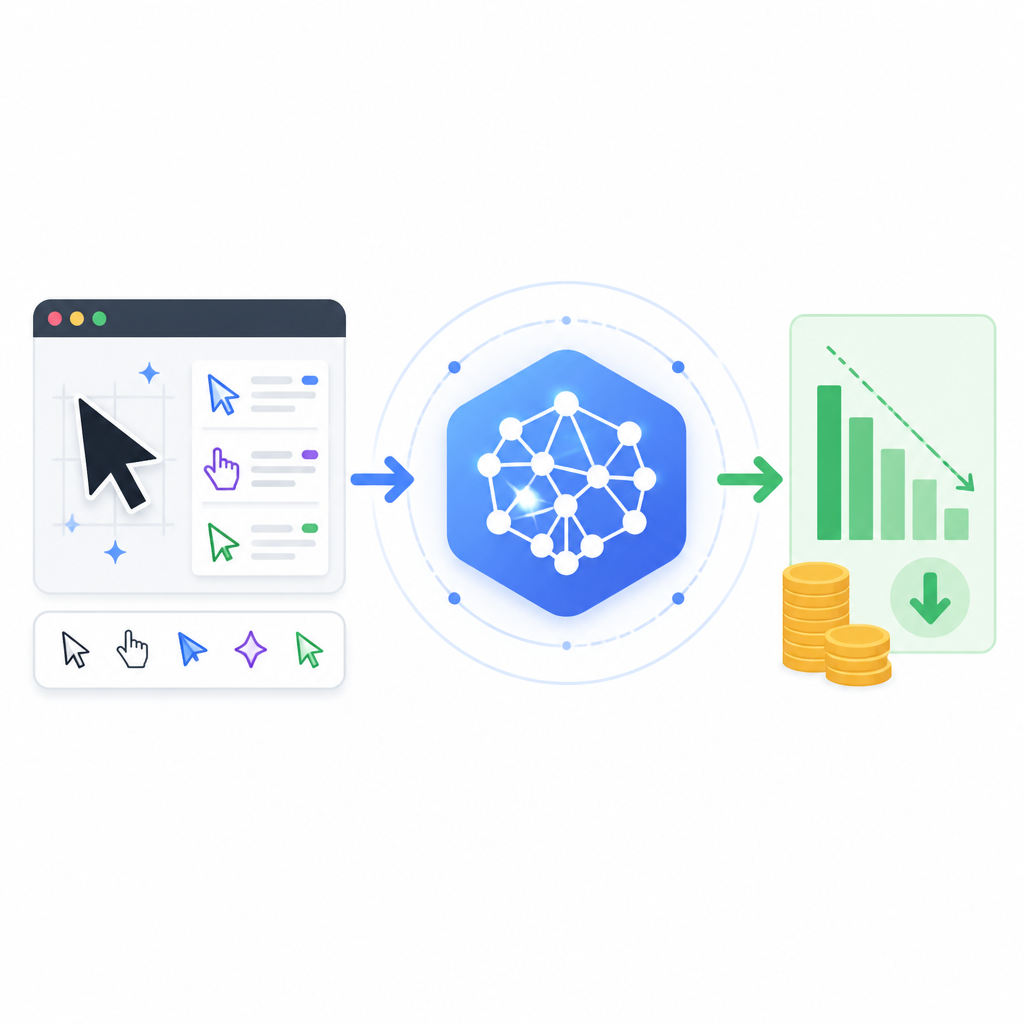
The reward signal is built from practical behavior, not abstract theory. Cursor looks at whether an edit survives in the codebase, whether the user sends a dissatisfied follow-up, and how much latency the session had. In an A/B test on Composer 1.5, Cursor says the system improved persistent edits by 2.28%, reduced unhappy follow-ups by 3.13%, and cut response latency by 10.3%.
- Five-hour loop from data collection to rollout
- 2.28% more edits stayed in the codebase in the test
- 3.13% fewer unhappy follow-ups
- 10.3% lower response latency
That sounds efficient, but it also raises privacy questions. Cursor says the model learns from acceptance and rejection patterns, not from raw code as a text corpus, yet those signals still come from real sessions. Enterprise customers who want tighter control need the Business plan with privacy mode enabled.
The pricing gap is the whole point
For teams that run long coding sessions, the economics are almost absurd. A 2-million-token session with a 70/30 input-output split costs about $2.20 on Composer 2.5 Standard. The same session lands around $66 on Opus 4.7 or GPT-5.5. That is a difference large enough to change how often teams can let an agent explore, refactor, and test.
Here is the practical comparison:
- Composer 2.5 Standard costs about 3% to 4% of frontier-model pricing for the same session profile
- Composer 2.5 Fast costs about 20% of Opus 4.7 for similar stated capability
- Cursor can keep the editor price low because it controls both the product surface and the training loop
- Open-weight bases like Kimi K2.5 make this pricing strategy possible without starting from scratch
That does not mean the model is free of trade-offs. Lower cost can tempt teams to use it more aggressively, which makes its training policy, privacy handling, and attribution rules more important, not less. If your codebase is sensitive, the real question is whether the savings are worth the data exposure and policy complexity.
What developers should watch next
Composer 2.5 is a sign that coding models are entering a price war where open-weight bases and fast post-training loops matter as much as benchmark bragging rights. If Cursor can keep improving the model on live usage without upsetting enterprise customers, rivals will have to answer with better pricing or better controls.
My bet is simple: the next big split in AI coding will not be between “good” and “bad” models. It will be between products that can learn from real developer behavior at scale and products that still need expensive lab training cycles. The teams that care about cost per refactor, not just benchmark scores, will feel that shift first.
If you want more coverage of coding agents and editor-native AI, read our related piece on Claude Code skills for UI/UX work.
// Related Articles
- [TOOLS]
Magenta RealTime 2 lets you score in the DAW
- [TOOLS]
Open-source AI tools beat Claude’s paid tiers on value
- [TOOLS]
500 AI agent projects show where agents work now
- [TOOLS]
Chocolatey’s Go package turns installs into policy
- [TOOLS]
Go support policy turns releases into a checklist
- [TOOLS]
RustDesk self-hosting setup for secure remote access