Microsoft open-sources 174 AI coding skills
Microsoft’s new GitHub repo packages 174 skills, MCP configs, and custom agents for coding assistants working with Azure SDKs.
Microsoft’s GitHub repo packages 174 skills and agent configs for coding assistants.
Microsoft has published microsoft/skills, a public repository built to give AI coding agents more context when they work with Azure SDKs and Microsoft AI Foundry. The repo already lists 174 skills, with installable templates for custom agents, AGENTS.md files, and MCP configurations.
The project is still marked work in progress, but the direction is clear: instead of asking a general-purpose coding assistant to infer SDK patterns from scratch, Microsoft wants developers to load the right task-specific guidance into the agent before it writes code.
| Item | Count or detail |
|---|---|
| Skills in the catalog | 174 |
| Quick install command | npx skills add microsoft/skills |
| GitHub stars | 2.3k |
| Forks | 261 |
| Recent commit count shown on repo | 564 |
What Microsoft is actually shipping
Get the latest AI news in your inbox
Weekly picks of model releases, tools, and deep dives — no spam, unsubscribe anytime.
No spam. Unsubscribe at any time.
The repo is more than a pile of prompts. It bundles skills, plugins, role-specific agents, reusable Agents.md templates, and MCP server configs that can be dropped into agent workflows. Microsoft also points to a skill explorer that lets developers browse the catalog and install a single skill instead of copying an entire library into context.
That choice matters because the repo is aimed at coding agents that already know how to write code, but do not automatically know the conventions of a specific SDK. Microsoft says the patterns are already in the model weights from pretraining, and the missing piece is the activation context that pulls the right pattern into view.
- Core skills cover areas like cloud architecture, GitHub issue creation, frontend review, and MCP server setup.
- Language-specific packs include Python, .NET, TypeScript, Java, and Rust.
- Foundry-focused skills cover projects, hosted agents, toolboxes, workflows, memory, governance, and observability.
Why the repo warns against loading everything
Microsoft is unusually direct about a problem most teams will hit fast: too many skills can hurt output quality. The repo warns that loading every skill causes context rot, which it defines as diluted attention, wasted tokens, and mixed-up patterns. That is a useful reminder for anyone treating agent setup like a giant prompt dump.
The advice is practical. If a project needs Cosmos DB work, then a Cosmos-specific skill is more useful than a general folder of 174 files. If a team is building an MCP server, the mcp-builder skill is the direct fit. If the goal is to shape agent behavior, the skill-creator guidance is the place to start.
“The patterns are already in their weights from pretraining. All you need is the right activation context to surface them.” — Microsoft, microsoft/skills README
That line captures the philosophy behind the repo. Microsoft is betting that good agent output depends less on bigger models and more on better grounding: the right instructions, the right tool list, and the right project-specific assumptions.
How the catalog is organized
The catalog is split into several layers. There are language-agnostic core skills, Foundry skills, and language packs for Python, .NET, TypeScript, Java, and Rust. The repo also includes prebuilt MCP configurations for docs, GitHub, and browser automation, which makes it easier to wire agents into external tools without rebuilding the plumbing every time.
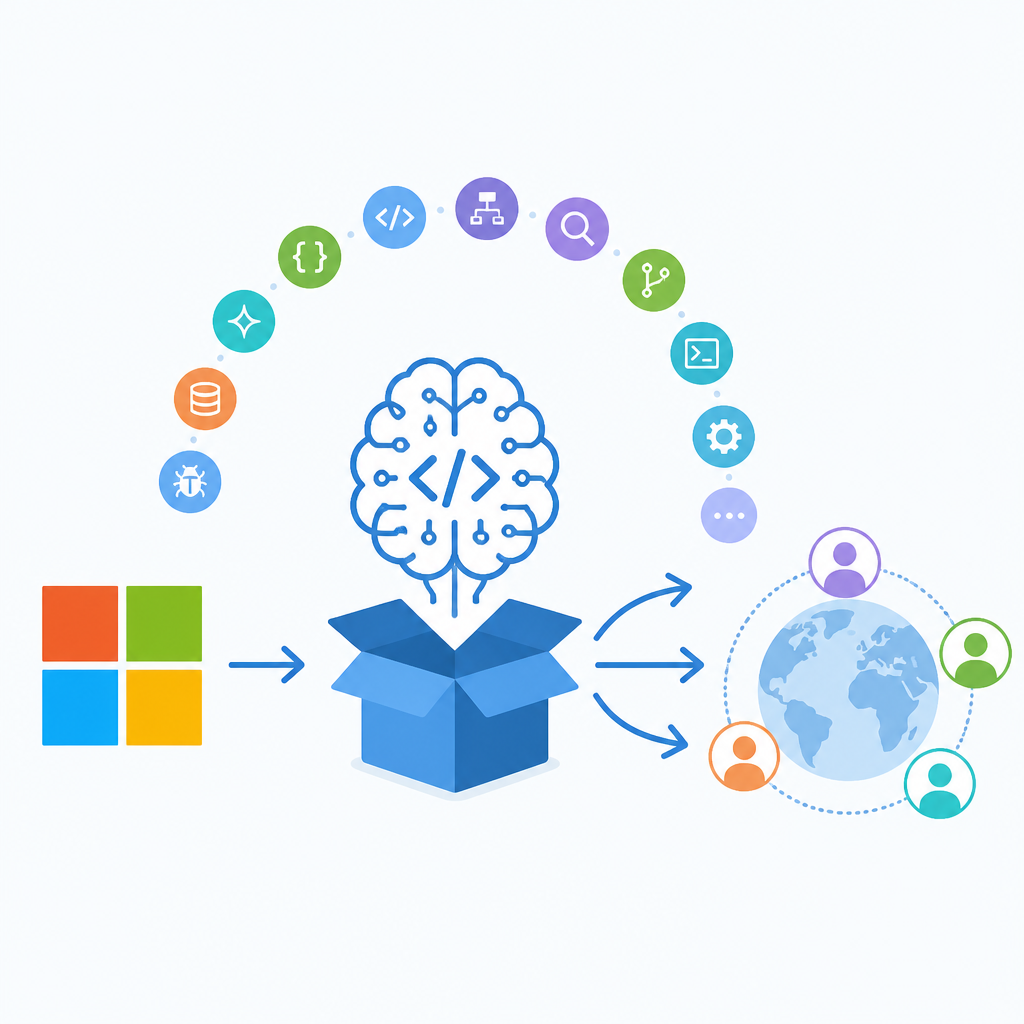
Some of the most interesting entries are the ones that point beyond simple code completion. Microsoft includes skills for hosted agents, agent identity, managed memory, observability, and multi-agent workflows. That suggests the company is thinking about agents as systems, not as isolated autocomplete helpers.
- Foundry skills: 11 entries covering projects, models, hosted agents, toolboxes, workflows, and governance.
- Python skills: 39 entries, the biggest language pack in the repo.
- .NET skills: 28 entries, followed by TypeScript with 25 and Java with 25.
- Rust skills: 7 entries, which is small but still useful for teams building in that ecosystem.
What this means for GitHub Copilot and other agents
The repo is clearly written with tools like GitHub Copilot in mind, especially Copilot CLI and Copilot in VS Code. But the pattern is broader than GitHub alone. The instructions mention sharing skills across multiple agent configs, including Continue-style setups and other local agent directories, which makes the repo useful even if your team does not live inside one editor.
There is also a strong “distribution” story here. The quick-start command is short, the install flow is wizard-driven, and the repo includes symlink examples for teams that want one shared skill set across projects. That is the kind of detail that usually decides whether a repo becomes a reference point or just another bookmark.
For developers working with Azure SDKs, the payoff is simple: fewer generic answers, more SDK-aware code, and a better chance that the agent follows the project’s own conventions instead of inventing new ones. For teams building on Microsoft AI Foundry, the repo also hints at a larger strategy where skills, toolboxes, and hosted agents all fit into the same workflow.
Where this goes next
The repo is still moving, and Microsoft says more skills are coming, existing ones are being updated to match the latest SDK patterns, and tests are being expanded. That matters because agent tooling tends to age quickly; a skill pack that is useful today can become noisy if it is not kept in sync with SDK releases.
If Microsoft keeps the catalog curated and the install flow simple, this repo could become a standard way to ground coding agents in Azure and Foundry projects. The real question for teams is whether they will treat skills as a one-time setup step or as part of normal project maintenance, right next to dependencies, docs, and tests.
For now, the takeaway is straightforward: if your AI assistant keeps missing SDK conventions, the fix may be a smaller, better-targeted skill pack rather than a larger model.
// Related Articles
- [TOOLS]
Aliyun Bailian Token Plan turns credits into agents
- [TOOLS]
One API gateway turns six AI APIs into one
- [TOOLS]
OpenAI FDEs turn broken agents into shipped systems
- [TOOLS]
Anthropic’s daily brief turns news into a workflow
- [TOOLS]
Claude Reflect turns usage into retention
- [TOOLS]
Midjourney turns prompt ideas into art