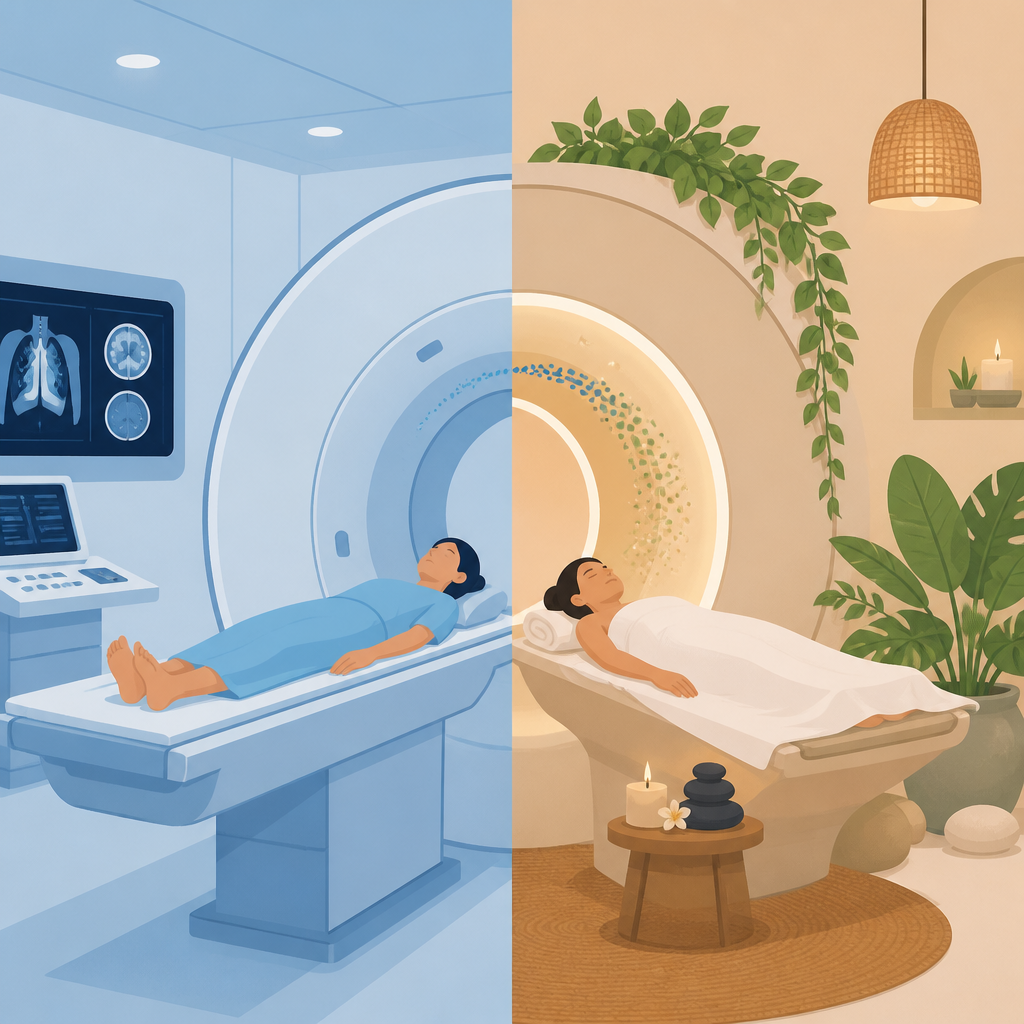
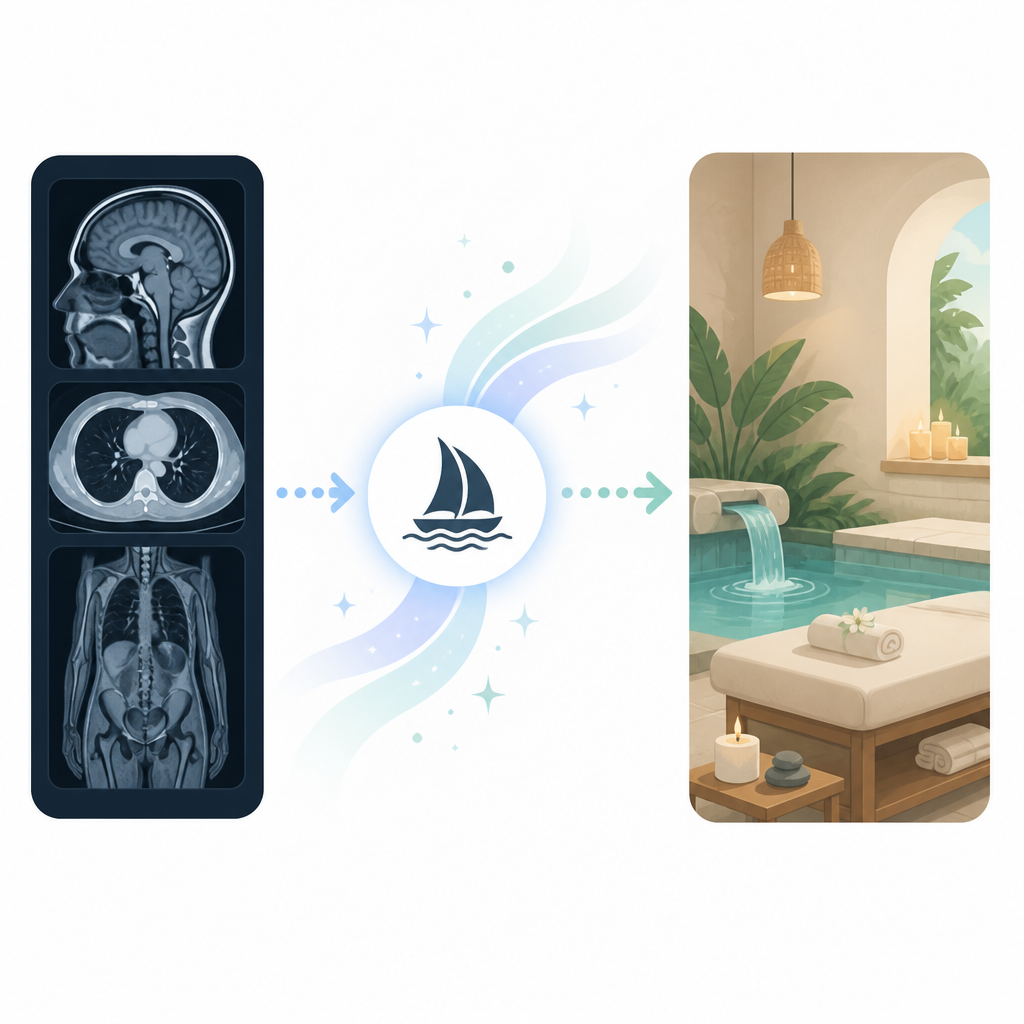
Midjourney Medical turns imaging into a spa-like health center with massive scan volume.
I’ve been using Midjourney for a while now, mostly as the thing I open when I want visual ideas to stop being boring. But this medical teaser hit me sideways. It doesn’t read like product copy from a company that wants to sell you a tool. It reads like someone trying to reframe the whole experience of health screening, and honestly, that’s what made me stop and reread it.
What’s off in the usual setup is obvious: scans feel cold, clinical, and expensive, then you wait around for answers like the machine is doing you a favor. Midjourney’s pitch flips that mood completely. Instead of a lab vibe, it imagines a flagship health spa. Hot tubs. Saunas. Cold plunges. Ten scanners. I’m not saying the idea is automatically good, but it is specific enough to be annoying in the right way. It makes you ask why medical imaging has to feel like punishment.
This piece is me breaking down the framing, not pretending the source is a finished product plan. I’m pulling apart the language, the implied workflow, and the weirdly deliberate choice to make wellness and diagnostics share the same roof.
Source anchor: the original line comes from Midjourney Medical on Midjourney’s site, which describes a flagship health spa called the “Midjourney Spa.”
They didn’t pitch a clinic. They pitched a place people might actually enter
Get the latest AI news in your inbox
Weekly picks of model releases, tools, and deep dives — no spam, unsubscribe anytime.
No spam. Unsubscribe at any time.
The center itself is a flagship health spa we are calling the “Midjourney Spa.”
What this actually means is the first move is emotional, not technical. They’re not leading with scanners, throughput, or clinical accuracy. They’re leading with the kind of place you’d willingly spend time in. That matters because most health tech copy assumes people are already sold on the experience of being monitored. They’re not. People avoid screening when the environment feels like a warning label with fluorescent lights.
I’ve seen this mistake over and over in product work. Teams obsess over capability and then wonder why adoption stalls. If the room feels hostile, every feature inherits that hostility. The word “spa” is doing a lot of work here. It lowers the psychological cost of showing up. It says, maybe this won’t be miserable.
How to apply it: if you’re building anything health-adjacent, stop describing the machine first. Describe the feeling of the first five minutes. What does the user see, hear, sit on, and worry about? If your offer is diagnostic, the experience still needs hospitality. People don’t just buy certainty. They buy the chance to face uncertainty without hating the process.
There’s also a branding lesson here that I think a lot of teams miss. You can’t always win by sounding more serious. Sometimes “serious” just means “hard to approach.” Midjourney knows how to make an idea feel strange enough to remember, and that’s a real advantage when the category is naturally dull.
The wellness props are not decoration. They’re the product wrapper
It will have hot tubs, saunas, cold plunges...
What this actually means is they’re bundling recovery theater with diagnostics. That may sound glib, but I mean it literally. The hot tubs, saunas, and cold plunges are not random amenities. They’re a signal that the scan is part of a broader health ritual, not an isolated medical event.
I ran into this idea when I watched people treat fitness apps like chores. The app that only counts your mistakes gets ignored. The app that gives you a ritual gets used. Same thing here. If the scan is framed as one stop in a larger wellness circuit, it becomes easier to schedule, easier to justify, and easier to repeat.
There’s a practical product lesson buried in that. If you want repeat behavior, don’t make the user leave the experience and come back in a totally different emotional state. Keep the context warm. Keep the transition simple. The spa elements do that. They create continuity between “I’m taking care of myself” and “I’m getting scanned.”
How to apply it:
Pair the core action with a softer adjacent ritual.
Make waiting feel like part of the experience, not dead time.
Design the handoff so the user doesn’t feel like they crossed from lifestyle into punishment.
And yes, I can already hear the objection: this risks turning medicine into branding fluff. Fair. But the counterpoint is that bad environments already shape behavior, just in a negative direction. If you don’t design the wrapper, the wrapper gets designed by hospital anxiety and paperwork.
Ten scanners is a throughput statement, not a vibes statement
...and 10 scanners with the capability to do more body scans a year than all MRI scanners on Earth combined.
What this actually means is Midjourney isn’t just imagining a boutique wellness club. It’s imagining industrial-scale imaging capacity. That line is the tell. The spa language gets attention, but the scanner count is the real operational claim. They’re saying this thing could move volume, not just host rich people in robes.
I’m careful with claims like this because the source text gives the statement, but not the underlying math or operating assumptions. So I’m not going to pretend I can validate it from the snippet alone. What I can say is that the framing is doing two jobs at once: making the place feel human, then making the machine feel enormous.
That duality is smart. Most teams pick one side and get trapped there. If you only sell luxury, you sound unserious. If you only sell scale, you sound sterile. Midjourney is trying to hold both. That’s rare, and honestly a little weird, which is probably why it sticks in your head.
How to apply it:
When you write about capacity, don’t bury it in a spec sheet if the number is part of the story. Put the scale claim next to the experience claim, then explain what the scale enables. In a product context, that could mean more screenings, faster turnaround, or lower friction. But don’t just say “more.” Say what more changes for the user.
Experience claim: why someone would show up.
Scale claim: why the system matters operationally.
Outcome claim: what changes after the scan.
That’s the structure I’d use if I were turning this into a pitch deck or landing page. It keeps the emotional hook and the business logic in the same frame.
The weird part is the real strategy: make diagnostics feel aspirational
What I keep coming back to is the category shift. Medical imaging is usually framed as something you endure. Midjourney is trying to make it something you choose because it feels aligned with how you want to live. That’s a much harder sell, but it’s also a much more interesting one.
I’ve built enough products to know that “aspirational” is a dangerous word when people are talking about health. You can’t dress up every serious thing and call it progress. But you can reduce dread. You can remove the sense that the experience is a penalty. That’s probably the cleanest read here: not glamour, not gimmick, just fewer reasons to avoid care.
If you’re writing your own version of this, focus on the tension. Don’t over-explain the spa. Don’t over-explain the scanners. Let the contrast do the work. The spa makes you comfortable enough to stay. The scanners make the visit worth something. The friction is the point.
How to apply it:
Write one line that makes the service feel desirable.
Write one line that proves the service is real and operationally serious.
Write one line that says what the user gets after the experience.
That’s the pattern I’d steal here. Not the brand name, not the exact amenities, but the sequencing. Emotion first, proof second, outcome last. That order matters more than people admit.
Midjourney’s trick is making a machine sound like a destination
There’s a reason this sticks. The source text doesn’t sound like a normal healthcare announcement. It sounds like a place. And places are easier to picture, easier to talk about, and easier to sell than abstract systems. Midjourney knows that from years of making visual outputs people want to share.
I think the real lesson for developers is simple: if your product is hard to understand, anchor it in an environment people can picture. Not a metaphor soup. A real environment. A room. A workflow. A sequence of actions. Midjourney chose a spa because everyone understands what a spa promises before they understand what the scanners do.
That doesn’t make the concept automatically good or bad. It just makes it legible. And in product writing, legible usually beats clever. You can always add complexity later. You can’t recover from a first impression that feels like a spreadsheet.
How to apply it:
Pick one concrete setting that matches the emotional job of your product. Then build the copy around that setting instead of around abstract features. If your product is about diagnosis, maybe the setting is a calm health club. If it’s about collaboration, maybe it’s a workshop table, not a dashboard. The setting should do part of the persuasion for you.
And if you’re wondering whether this is too much branding for something medical, yeah, maybe. But the source is already making that bet. The useful part for me is not whether I’d copy the whole thing. It’s that I now have a cleaner way to think about reducing friction in high-anxiety products.
The template you can copy
# Diagnostic wellness center copy template

We’re building a place people can actually walk into without dreading the experience.

## What it is
A health center that combines imaging, screening, and recovery-friendly amenities in one calm environment.

## Why it feels different
- The room feels like hospitality, not punishment.
- The core diagnostic step is surrounded by lower-stress rituals.
- The experience is designed to reduce avoidance.

## What it includes
- High-throughput scanning equipment
- Comfortable waiting and recovery spaces
- Wellness amenities that make the visit feel complete

## Why the scale matters
The system is built to handle volume without turning the visit into a factory line.

## Copy block
"A flagship health center where scanning feels less like an ordeal and more like part of a larger care ritual."

## If you’re writing the landing page
1. Start with the emotional promise.
2. Name the diagnostic capability.
3. Explain the user outcome.
4. Mention the environment only after the value is clear.

## If you’re writing product copy
- Lead with the experience.
- Back it up with operational proof.
- End with what changes for the user.

## If you’re building the product
- Design the entry experience first.
- Make waiting feel intentional.
- Keep the transition from wellness to diagnostics smooth.
- Treat throughput as part of the user promise, not just an internal metric.
That template is intentionally plain because the source idea is doing the heavy lifting. You can drop your own product, category, or facility into it and rewrite the specifics without losing the structure.
Original source: https://www.midjourney.com/medical. My breakdown is original commentary built from that text, not a claim that Midjourney has published a full operational spec.